
 Opinion Leaders
Corporate earnings progressing at a solid pace
-
Andrea Conti
Head of the Macro Markets Analysis
Eurizon
The initial indications provided by the 3Q 2026 earnings reporting season in the US draw a positive picture, albeit less brilliant than in the previous quarters.
The results posted by the major banks were in line with expectations. The first indications provided by technology sector companies confirm expectations for strong demand and revenue growth, while investor focus is now on the financial sustainability of investment in artificial intelligence (AI).
Twenty-five-per-cent of S&P500 companies have disclosed their results, with 80% beating earnings expectations, falling only slightly short of the previous reporting season but staying well above the long-term average.
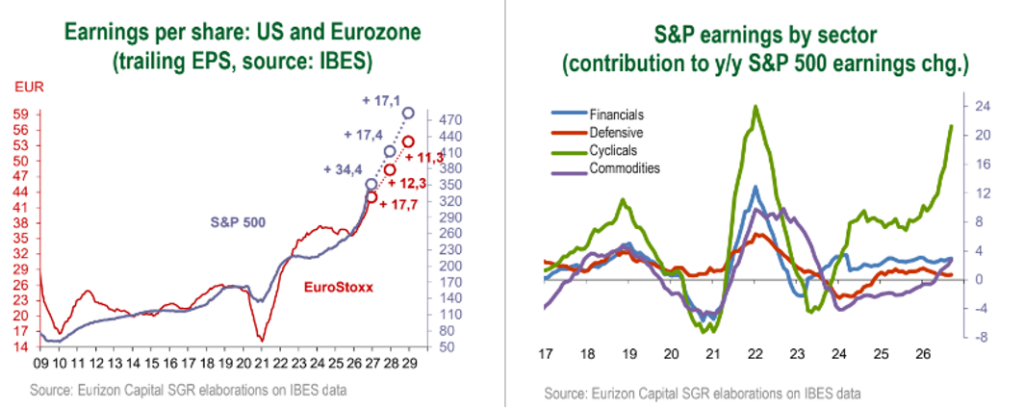
Earnings estimates, revised up during 3Q, point to robust annual growth of 27%, after the exceptional +32% result achieved in the previous quarter.
Ten out of the 11 sectors represented in the index are forecast to report positive results, confirming an increasingly widespread earnings dynamic across companies and business sectors. Earnings growth is expected to be spearheaded (with double-digit rates) by energy, technology, communication services, basic materials, and industrials.
In the Eurozone, EuroStoxx earnings are estimated to show solid growth, by 22% y/y, supported by a livelier than expected economic recovery and by heftier earnings estimate upgrades, in particular in the energy, industrial, and technology sectors.
The excellent results posted by US companies during the previous quarterly earnings seasons prompted analysts to revise up their estimates for 3Q profits. Expectations were further upgraded as the current reporting season got under way.
Forecast earnings growth is 28% in 4Q 2026 and has been revised up to 34.4% for full-year 2026, thanks to the contribution of the tech sector, to the recovery of the energy sector, and to generally more widespread growth across business sectors.
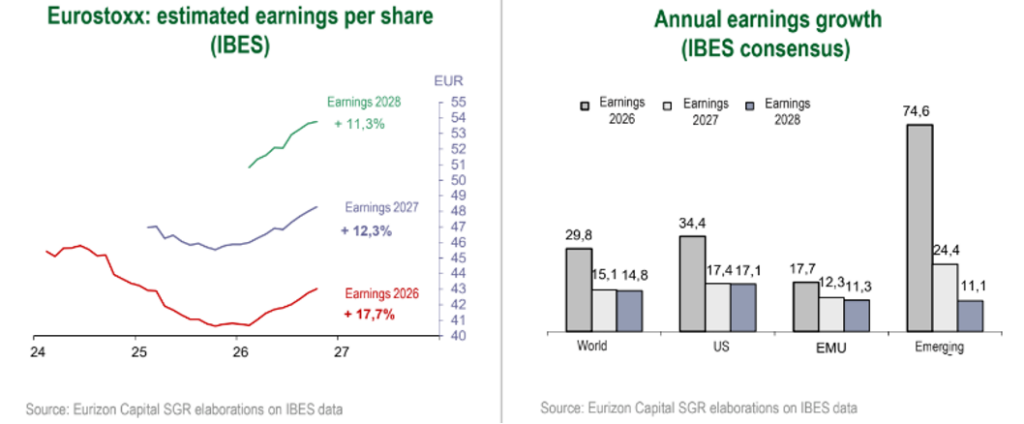
Estimates for 2026 are high on the other major markets as well. In the Eurozone, EuroStoxx corporate earnings are forecast to accelerate by 17.7% after proving stagnant in 2025. Progress on the emerging markets should be even stronger, with estimates pointing to an exceptional +74.6% growth in earnings, supported by the acceleration of technological development.
At the global level, earnings are expected higher by 29.8% this year and by around 15% in the two following years, thus offering the stock markets substantial support.
The second half of 2026 began with resurging political tensions in the Middle East, which drove up energy prices and inflation. All the same, the global economy proved resilient, and corporate earnings continued to grow.
Inflation risks have prompted the major Central Banks to simultaneously hike interest rates. The combination of solid growth, persistent inflation, policy rate hikes, and concerns over large fiscal deficits, resulted in a visible increase of government bond yields, reabsorbed only in part at the beginning of October.
However, political tensions and rising yields put the stock markets on hold. From 30 June to 23 October, the performance of the MSCI AC World index was flat (12.4% since the beginning of the year). The balance was positive in the US (2.0%) but negative in the Eurozone (-4.3%) and the emerging economies (-9.8%), the latter affected by profit-taking in the technology sector.
Stocks showed only a modest reaction to the release of quarterly earnings. In the United States, the companies that beat estimates experienced limited gains, that fell short of the long-term average. Investor sentiment is being driven more by the earnings outlook than by quarterly results in themselves.
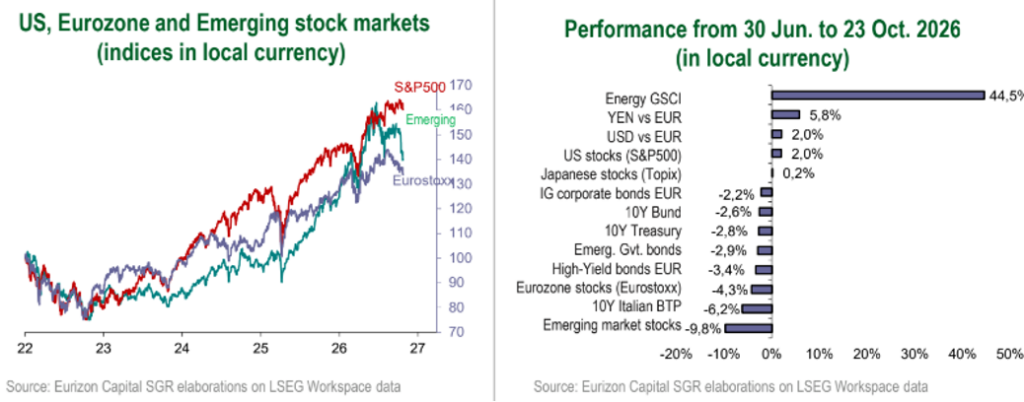
The US stock market has been experiencing a consolidation phase since August, when the price of oil started to rise back up. On the other hand, the Eurozone markets (EuroStoxx) and the emerging stock lists dropped back from the peaks marked last summer.
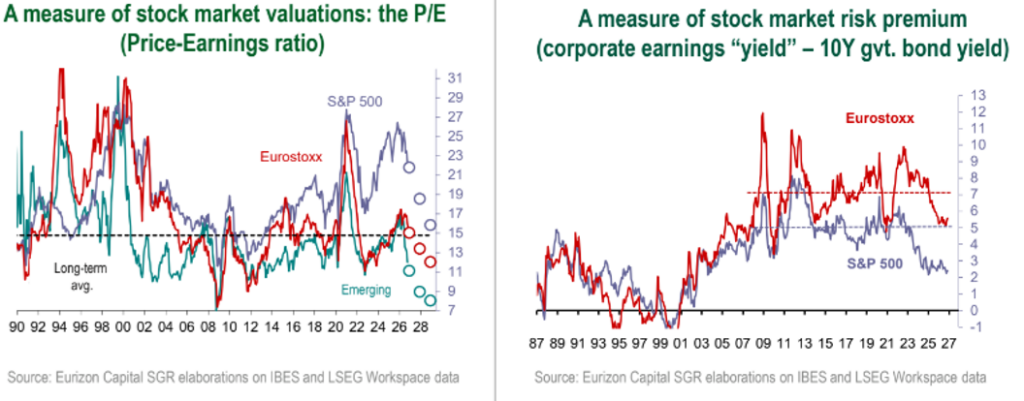
Valuations (price-earnings ratio), after having reached period highs in the first half of the year, dropped on all the markets thanks to strong corporate earnings growth. On the S&P500, valuations are now lower than the troughs marked in May 2025.
Furthermore, the additional upward revisions of estimates have resulted in a significant drop in prospected valuations: on the S&P500, forecast multiples for 2027 and 2028 are now lower than they were in 2022; on the EuroStoxx they are back to levels below the long-term averages, whereas on the emerging markets they have plunged to below 2020 lows.
Earnings growth, increasingly widespread across markets and business sectors, continues to act as a solid supportive factor for the stock market, whereas more contained valuations make the picture more protective in case of potential corrections.