

 Opinion Leaders
Demand for euro-denominated investment-grade bonds remains strong
-
Bonnie Abdul-Aziz
Head of European Credit
Insight Investment
Euro-denominated investment-grade (IG) bonds continue to occupy an attractive middle ground between lower-risk government bonds and higher-risk high-yield bonds.
We believe this asset class remains compelling for investors seeking income and diversification, even though current market conditions present certain challenges. In our view, corporate fundamentals generally appear favourable, whilst yields remain at levels that are attractive compared with historical averages. We view strong investor demand as a further factor supporting this asset class. However, this is offset by a number of less favourable factors. These include valuations that are considered expensive when measured against the credit spread relative to government bonds, as well as the growing volume of new issues.
Attractive yield potential with low default risk
For many investors, generating income remains the primary objective. After years of extremely low interest rates, euro-denominated investment-grade bonds now offer yields that can make a significant contribution to portfolio returns.
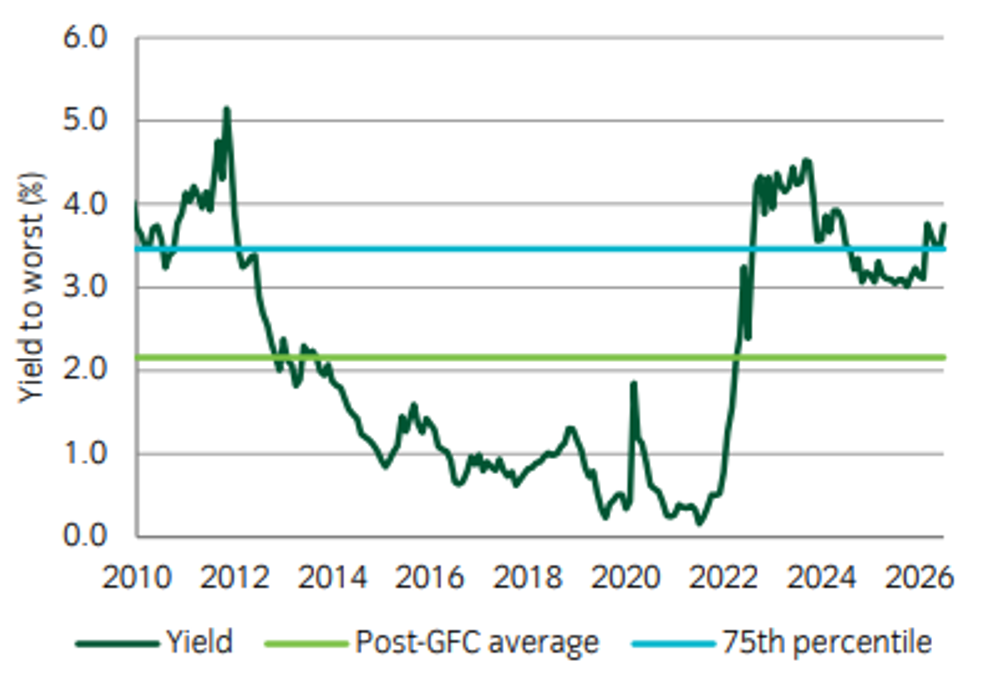
Yields on euro-denominated investment-grade bonds remain well above the levels seen following the global financial crisis1.
Although yields are lower than in the high-yield markets, this may be accompanied by a significantly lower risk of default. As a study by S&P Global from August 2025 shows, there have been only seven defaults in the market for euro-denominated investment-grade corporate bonds since 1991, with not a single default recorded in the last 17 years2.
Strong corporate fundamentals
A key pillar of the market is the generally sound state of corporate balance sheets. Recent earnings have proved resilient despite slower economic growth in many sectors. Corporate profitability remains reasonable, and refinancing activity has been manageable. The primary market remains active and frequently offers investors new opportunities. However, an increase in supply can tend to lead to a fall in bond prices. Given the strong issuance activity we are currently seeing in the pipeline, we therefore consider it advisable to thoroughly analyse new issues for their value potential. By financing extensive investment programmes in the fields of artificial intelligence and digital infrastructure, issuers could open the door to new and potentially transformative economic opportunities. Furthermore, new bonds often come to market with slightly higher yields than comparable bonds already trading on the secondary market, which potentially enhances opportunities for active investors.
Valuations are becoming increasingly tight
The main concern is probably that spreads have become very tight. When spreads are tight, investors receive a lower return for taking on credit risk. The risk-return ratio appears less attractive than in previous years. Much of the positive news has already been priced into the market, yet in recent years the financial position of many countries has deteriorated significantly following years of substantial deficits – particularly in the wake of the COVID-19 pandemic. Part of the narrowing of spreads may be attributable to government bonds being less resilient than in the past.
Should economic growth fall short of expectations, should geopolitical tensions rise, or should corporate profits decline, spreads could widen from their current levels, which could lead to losses in market value, even if companies continue to meet their payment obligations.
Growing bond supply and interest rate risk
Corporate demand for credit is rising. We expect that issuances in 2026 will be used to finance capital expenditure, merger and acquisition activity, and ongoing investment in artificial intelligence. A sustained rise in new supply could exert upward pressure on spreads should investor demand fail to keep pace. This ‘supply glut’ has not yet made itself felt to any significant extent. In the technology sector, however, there are already early signs of supply-driven pressure on spreads.
Although the European Central Bank has made significant progress in curbing inflation, there remains uncertainty regarding the future path of interest rates. Bond prices move inversely to yields, which means that an unexpected rise in government bond yields could put pressure on bond prices. Geopolitical developments, energy price shocks or renewed inflationary pressures could lead investors to reassess their monetary policy expectations.
The eurozone economy remains vulnerable to external shocks. Energy markets, trade tensions and geopolitical conflicts could affect corporate profitability and investor sentiment. Whilst investment-grade companies are generally well-positioned to weather moderate disruptions, periods of market stress may nevertheless lead to widening spreads and temporary capital losses.
Selective screening is becoming increasingly important
We believe that euro-denominated investment-grade bonds currently offer an attractive combination of yields, relatively sound corporate fundamentals and diversification benefits. Higher yields than in much of the past decade mean that investors receive significantly higher remuneration for holding corporate bonds. We also see significant opportunities for active managers to add value, as valuations are diverging across sectors and even between countries within the region. However, the market is no longer obviously cheap. Tight spreads, high issuance volumes and uncertainties regarding economic growth and interest rates mean that future returns may depend more on earnings generation and careful bond selection than on a further narrowing of spreads. For investors seeking moderate risk and income, euro-denominated investment-grade bonds remain attractive, but selective picking is important.
__
1Source: Bloomberg, Insight. As at 31 July 2026. Worst-case return of the Bloomberg Euro Agg IG Corporate Index. Post-global financial crisis = January 2010 to present.
2Source: S&P Global Ratings – Defaults, Rating Changes and Recoveries: Annual Study on Defaults and Rating Changes among European Companies 2024 – August 2025.