

 Opinion Leaders
High Yield: Total returns remain high
-
Anton Dombrovskiy
Portfoliospecialist
T. Rowe Price
Tight corporate credit spreads¹ may continue to dominate the discussion in global high-yield markets, but they do not tell the whole story.
Total returns remain high, default rates are low, and improved credit quality and liquidity paint a compelling picture. Taken together, these four factors not only help to explain the narrowing of spreads but also provide strong arguments for allocating to high-yield bonds.
Total return is key
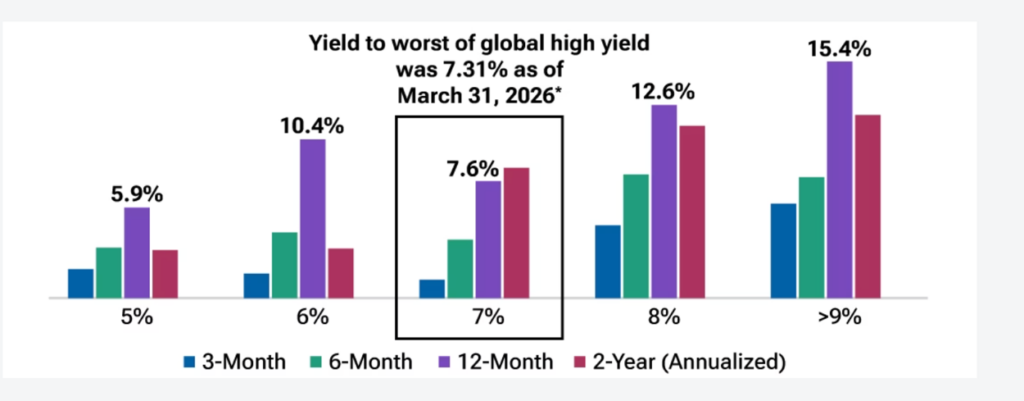
Total returns remain high and are attractive from an income-generation perspective. Historically, investments at this level have been a precursor to attractive returns in subsequent periods.
Interestingly, these yields can sometimes underestimate the actual return potential. In sub-investment-grade markets, bonds are often refinanced before maturity – a dynamic that can have a significant impact on expected returns but is not usually reflected in the stated yields to maturity. Taking this early repayment into account for bonds trading below par typically results in total returns that exceed the stated yields, further enhancing the attractiveness of high-yield bonds on an absolute basis.
A comparison with other asset classes, such as equities, is also compelling. As at 21 May, the J.P. Morgan Domestic High-Yield Index offered a ‘yield to worst’ of 7.13 per cent, which is more than three percentage points above the earnings yield of the S&P 500 Index2. This difference is remarkable not only from a return perspective, but also because, historically, the volatility of shares has exceeded that of high-yield bonds. Superior returns, significantly lower volatility and a potentially lower downside risk compared with shares are strong arguments in favour of this asset class.
Improved credit quality
The overall credit quality of high-yield corporate bond indices has improved significantly over the last 15 to 20 years. Taking the ICE BofA Global High Yield Index as a benchmark, 62 per cent of the bonds as at 31 March 2026 are rated BB (the highest rating below investment grade), compared with just 39 per cent in 2007. This improvement in credit quality is also evident at the other end of the high-yield spectrum. The proportion of issuers with a CCC rating fell from an average of around 15 per cent of the index in 2007 to just 7 per cent at the end of March this year.3
Increase in the number of issuers with a BB rating

A further indication of improved creditworthiness is the rise in the issuance of covered bonds. This points to higher repayment rates⁴, as investors can assert claims on specific assets or collateral. Furthermore, a key trend following the global financial crisis (GFC) was a sharp decline in the volume of smaller transactions. This is significant because smaller transactions tend to be more speculative, as issuers are often at an earlier stage of development and are more heavily indebted, meaning that their credit profiles are generally weaker. Fewer small transactions point to healthier market conditions.
Furthermore, high-yield companies are, on average, generating higher profits than before the global financial crisis, which gives them greater financial flexibility. The average maturity and duration profile of high-yield issuers have also shortened significantly over time, leading to a reduction in both volatility and the risk premium demanded by investors. Overall, improvements in credit quality in the high-yield market have contributed to tighter credit spreads.
Low default rates
Default rates in global high-yield markets remain below historical averages – a trend we expect to continue. Whilst concerns about the software sector and retail lending are currently high, we do not believe this points to wider problems in the credit markets. High-yield companies are underpinned by robust fundamentals. Cash ratios (a liquidity metric that indicates a company’s ability to cover its short-term liabilities) are high, whilst debt ratios (which show how much of a company’s capital comes from debt) remain relatively healthy.
High-yield companies have also demonstrated considerable resilience in recent years, weathering numerous shocks – from Covid to the 2022 energy crisis and tariffs. Taken together, these characteristics underpin high-yield companies and are likely to help them weather this year’s energy price shock.
Improved liquidity
In addition to default risk, high-yield investors should be compensated for volatility and illiquidity risk. However, liquidity in the global high-yield market has improved significantly in recent years, driven by the increasing prevalence of electronic trading and portfolio trading. Bid-ask spreads (the difference between the price buyers are willing to pay and the price sellers are willing to accept) have also narrowed – a further sign of improved liquidity.
Consequently, structurally improved liquidity means a lower required liquidity premium. This is a further factor contributing to the narrowing of spreads.
Advantages of a global approach in today’s markets
The global high-yield market has undergone a significant transformation over the past two decades. It is now around six times larger than it was in 2000 – an expansion that has created a more global and diverse investment universe, encompassing a wide range of countries, sectors and issuers.
This broader range of investment opportunities can enhance diversification by enabling exposure to different economic and credit cycles, which is particularly important for investors in today’s markets. It is undisputed that spreads are tight compared with historical levels. However, this must be viewed against the backdrop of significant structural changes in the global high-yield market. Credit quality has improved, companies are generally in sound financial health, and liquidity is better. These factors, combined with attractive and competitive total returns, clearly speak in favour of this asset class.
__
1The credit spread is the difference in yield between securities with similar maturities but different credit ratings. Widening spreads generally indicate a deterioration in the credit quality of corporate bond issuers, whilst narrowing spreads suggest an improvement in credit quality.
2The earnings yield is calculated as the consensus of expected earnings for the next 12 months divided by the share price. Source: Bloomberg Finance L.P.
3Issuers with a CCC rating belong to one of the lowest credit quality categories but are not in default.
4Recovery rates indicate the percentage of principal that an investor would recover in the event of a default.