Traditional macroeconomic indicators are generally monthly or quarterly in frequency and are therefore published at a delay compared to the period to which they refer.
In phases of strong uncertainty such as the present, higher-frequency indicators may be useful in attempting to promptly capture the indications provided by the economy; while less statistically accurate than traditional indices, they are available on a weekly or even daily basis.
These include for instance the Redbook Retail Sales Index, a weekly indicator of retail sales in the US. In the first three weeks of April, this index was up by 7.1% y/y, accelerating from 5.3% in March and suggesting ongoing consumption growth at sustained rates.
For the labour market, the Indeed Job Postings index, based on daily postings, stayed on a gradual downtrend in the first three weeks of April, deepening the decline already observed in recent months. This took place within a context of labour market normalisation, with no sudden setbacks.
Therefore, the scenario which emerges for the United States is characterised by essentially resilient real activity, in line with the picture drawn by traditional indicators.
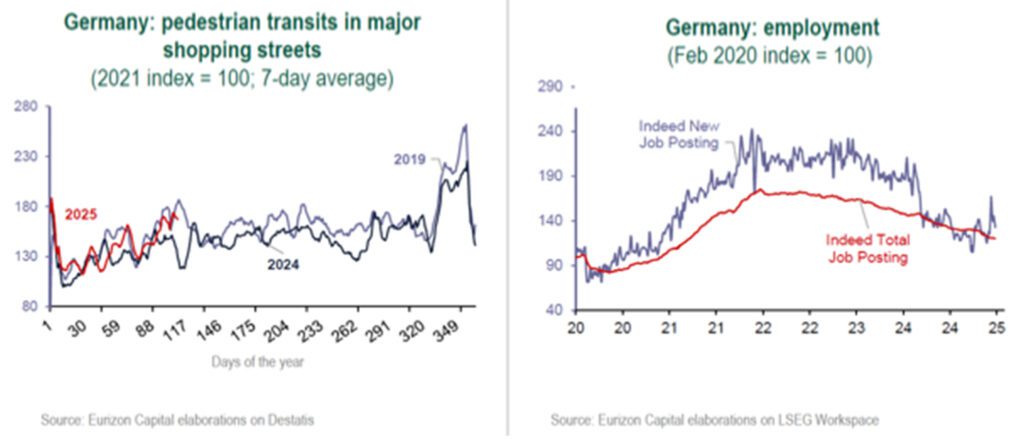
In Germany, in order to promptly assess the evolution of consumer spending, Destatis (the Federal Statistics Bureau) in collaboration with Bundesbank, monitors a daily indicator of the frequency of pedestrian transits in major shopping streets. While very volatile, the dynamics of this indicator in the first 20 days of April points to a limited recovery in sales.
For what concerns industrial activity, the truck toll mileage index in Germany, published by Destatis with monthly/daily frequency, and the dynamic of which tends to be correlated with the industrial output trend, seems to generally suggest a contained recovery of activity in March and in the first three weeks for April.
Lastly, for what concerns job growth, the dynamic of the Indeed Job Postings index for Germany in the first three weeks of April seems to be consistent with a continuation of the gradual downtrend already under way.
Taken together, these indicators outline a limited strengthening of economic activity in Germany.
In analysing inflation, useful input may come from some microeconomic indicators, such as the number of shopping basket items that record price increases, that are then compared to the pre-pandemic period.
In the US, the number of inflation basket items that recorded increases larger than the average for the 20 years prior to the pandemic fell in March, staying below the average for the 2000-2019 period.
The corresponding indicator for the Eurozone, on the other hand, increased slightly in March, levelling off at a higher level than the 20-year average.
Overall, it should be said that none of these indicators point to a recovery of inflation, or to a sudden impact of trade tariffs.
However, in the United States, persistently higher inflation levels than in the prepandemic period are due to a limited number of components, although prices pressures remain high.
By contrast, in the Eurozone, where average inflation is lower than in the US and closer to prepandemic levels, a larger number of goods are still recording larger price increases than in the previous regime.


 Opinion Leaders