
 Trading Desk
EUR/USD: It’s one thing after another
-

Wolfgang Hagl
Redaktor
With central bank decisions on the horizon, the euro-U.S. dollar exchange rate is taking center stage. Technical analysis, the interest rate differential, and the situation in France all suggest that the EUR/USD pair will continue to decline.
Exciting days lie ahead for FX traders. In less than 33 hours, three leading central banks will announce their interest rate decisions. The U.S. Federal Reserve will be the first to do so. The Federal Open Market Committee, chaired by Kevin Warsh, has been meeting in Washington, D.C., since yesterday. Today at 7:00 p.m., the markets will learn what the committee has agreed upon. Following that, the Fed Chair will hold a press conference. The European Central Bank will announce its decision on Thursday at 2:00 p.m. in Frankfurt am Main, before ECB President Christine Lagarde addresses the media. A similar procedure is scheduled for Friday morning in Tokyo. There, the Bank of Japan (BoJ) will announce its interest rate decision at 3:30 a.m. our time. Later, BoJ Governor Kazuo Ueda will address the press.
A Precarious Situation
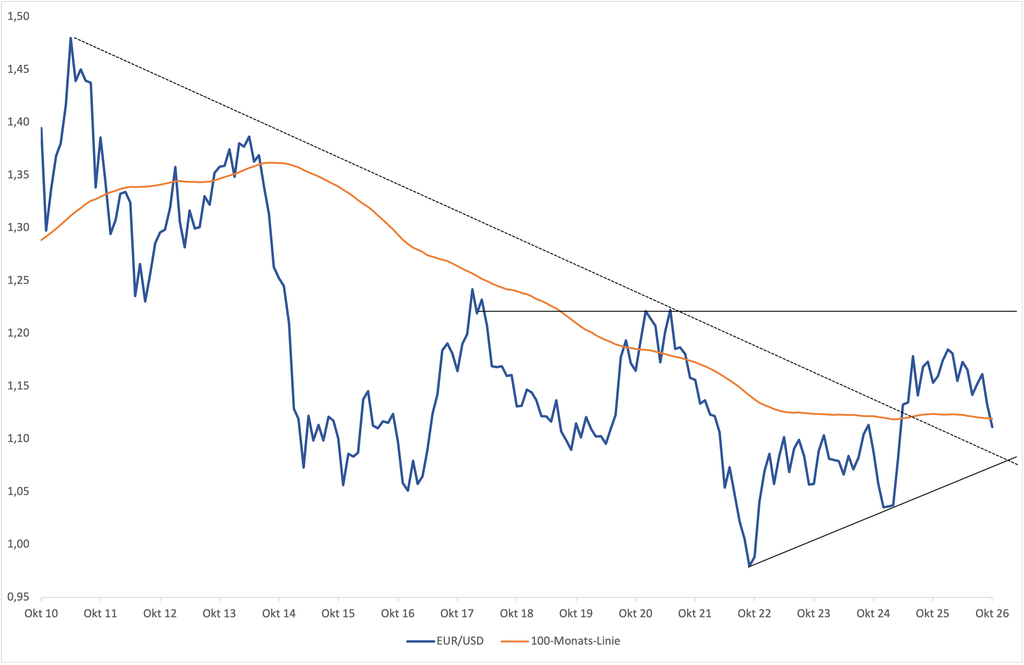
The upcoming monetary policy trilogy could have a significant impact on the exchange rates of the three currencies involved—the USD, EUR, and JPY. The focus is on the pair EUR/USD. This is all the more true given that the world’s most important exchange rate is in a precarious situation. The euro is on track to fall below the 100-month moving average for the first time in over five years. In the past, breaking below this level has repeatedly proven to be the starting point for more pronounced downward movements. When the euro fell below the 100-month moving average in the fall of 2021, it lost up to 18% against the dollar over the following twelve months. Jeremy Boulton, a market analyst at Reuters, also points out in a recent commentary that this moving average has, on several occasions in the past, put the brakes on upward movements in the euro.
Clear Expectations
Back to the central banks: The markets expect the Fed, the ECB, and the BoJ to keep their hands off the interest rate levers. In September, the three institutions responded to inflationary pressures with interest rate hikes. Although inflation is running rampant more than ever, the Fed is expected to keep its target rate in the range of 3.75 to 4.00% tonight. This scenario is supported not least by the midterm elections coming up in the U.S. in a week. As for the ECB, the money markets leave no doubt that the key rate will remain at 2.50%.
This makes the central bank chiefs’ appearances all the more anticipated. Both Warsh and Lagarde must explain why they are not tightening monetary policy despite high inflation risks and a resilient economy. Observers will also be watching closely to see whether the duo reinforces the general expectation of interest rate hikes in December.
Fascinating Questions
Christine Lagarde is likely to face further specific questions. For one thing, she will almost certainly have to comment on the situation in France. Last week, the yield on the country’s 10-year government bond reached a 24-year high of 5.1415%. In addition, the closely watched yield spread between French government bonds and German Bunds widened to 155 basis points. That would be the highest level since 2011. Although yields and the spread have retreated somewhat after Moody’s affirmed its rating for France, However, the problems remain.
And then tomorrow’s discussion is also likely to focus on the future of the ECB president. Lagarde could step down even before the official end of her term in October 2027. The Frenchwoman herself has raised the possibility of such a move—without providing any details about her plans. Lagarde is being touted as the future head of the World Economic Forum in Davos. A discussion—or even a power struggle—over the succession at the helm of the ECB would likely be anything but positive for the euro at this stage.
Investment Solution
The combination of technical analysis, issues in France, and the dollar’s interest rate advantage points to a downward trend in the EUR/USD pair. With the mini-future short SKIBTU Traders can bet that this scenario will intensify in the wake of the upcoming central bank meetings. The UBS product converts falling euro exchange rates into profits with a leverage ratio currently set at 8.6. The issuer has set the stop-loss at USD 1.2272, which is a good tenth above the underlying asset’s price. However, this margin does not change the fact that this trade could also result in disproportionately large losses if the underlying assumption does not materialize. The euro, which is currently oversold, could rebound, for example, if the midterm elections in the U.S. result in an unclear balance of power or if the Fed takes a relatively calm stance on inflation in its statement tonight.