

 Learning Curve
Forex: the fascinating world of currencies
-

Christian Ingerl
Redaktor
Developments in the foreign exchange markets are of great importance to investors. In certain situations, it may be advisable to hedge against exchange rate losses. Here, you can find out how it is done. At the same time, the foreign exchange markets offer a wide range of opportunities.
The war in the Middle East has not only sent shockwaves through the capital and commodity markets, but has also had a significant impact on exchange rates in the foreign exchange markets. The US dollar (USD) is one of the main beneficiaries of the conflict: it is regarded as a classic safe-haven currency in times of geopolitical crisis and has regained value against most other currencies since the outbreak of the latest hostilities. However, this rise must be viewed in relative terms, as the greenback had suffered significant losses in the preceding months. Over the course of twelve months, it declined by around 10% against the Swiss franc (CHF), just under 7% against the euro (EUR), and approximately 5% against the Chinese yuan (CNY).
There are several reasons why confidence in the US dollar has declined so sharply. These include, in particular, the strained financial situation of the US, characterised by high budget deficits and rising public debt, as well as persistently high inflation.
Keeping an eye on exchange rates
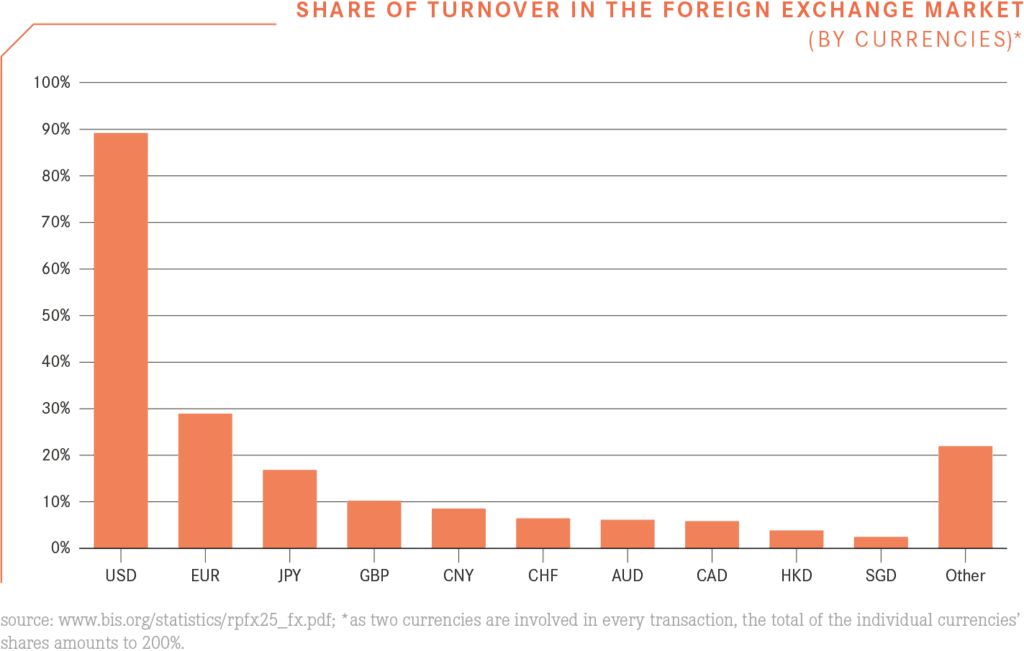
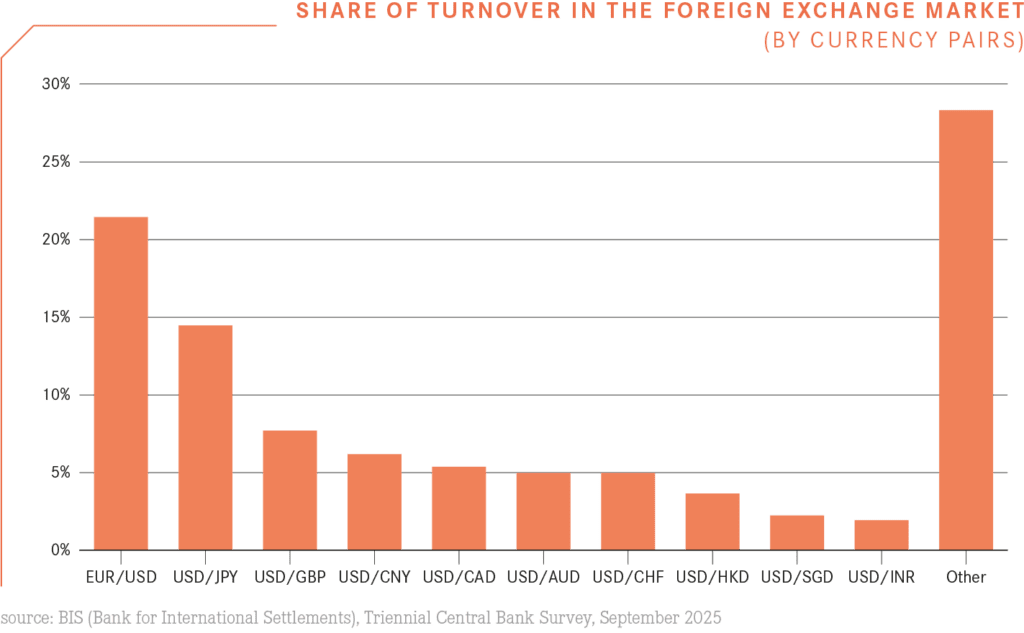
Compared to developments on the stock markets, movements on the foreign exchange market (Forex or FX for short) tend to attract less attention from many investors. Yet trends on the foreign exchange markets play a significant role. On the one hand, currencies represent an interesting asset class offering significant diversification benefits and high liquidity. With a daily trading volume of USD 9.6 trillion, Forex is by far the most liquid market in the world. On the other hand, exchange rate movements can have a decisive impact on investment performance. Anyone holding securities denominated in foreign currencies in their portfolio – such as US equities or ETFs tracking US indices – must bear in mind that fluctuations in the foreign currency against the home currency can affect returns: positively if the foreign currency appreciates, and negatively if it depreciates.
Example of exchange rate losses
Let’s suppose an S&P 500 ETF was purchased a year ago amounting to a total sum of USD 20,000. At that time, the USD/CHF exchange rate was still CHF 0.88, meaning the value of the investment in Swiss francs was CHF 17,600 at the time of purchase. Currently, the USD/CHF exchange rate stands at CHF 0.79, meaning that, assuming the S&P 500 index remains unchanged, the ETF is now worth only CHF 15,800. An exchange rate loss of CHF 1,800 has been recorded. Conversely, if the USD were to appreciate against the CHF, corresponding exchange rate gains would be possible. Notwithstanding, however, investors wish to eliminate exchange rate risk from foreign currency investments. This makes sense, as many experts expect the USD to depreciate again in the medium to long term.
FX hedging with Warrants
To reduce currency risk in a portfolio, it may be advisable to hedge the relevant position using leveraged products such as Warrants or Knock-outs. Any potential exchange rate loss on the investment is then reduced or fully offset by gains on the currency position. Let’s stick with the example of an ETF investment in the S&P 500 worth USD 20,000. As described above, this US asset is currently valued at CHF 15,800 at a USD/CHF exchange rate of CHF 0.79. Now, this position is to be hedged against exchange rate losses over a period of three months.
As a hedging instrument, a USD/CHF Put Warrant is selected with a three-month maturity, a strike price of CHF 0.79 (in-the-money), a ratio of 100, and an omega (leverage) of 11. The price per Warrant is CHF 2.95**. The price, multiplied by the omega, gives a hedge amount of CHF 32.45 per Warrant. To determine how many put Warrants are required, the amount to be hedged (CHF 15,800) is divided by the hedge amount per Warrant (CHF 32.45). This gives us 487 Put Warrants at a total price of around CHF 1,436.
Scenarios at maturity
Now, we assume that after three months, the USD/CHF exchange rate has fallen from an initial CHF 0.79 to CHF 0.74. In this case, the S&P 500 ETF (assuming the S&P 500 remains unchanged) would be worth only CHF 14,800. The loss compared to the original level amounts to CHF 1,000. On the other hand, the Put Warrant on the USD/CHF exchange rate would have built up an intrinsic value of CHF 5.00 at maturity. With 487 puts, this amounts to a value of CHF 2,435. After deducting the purchase price (CHF 1,436), a profit of around CHF 1,000 remains, which offsets the currency loss on S&P 500 ETF.
But be careful: if the USD/CHF exchange rate remains stable or the USD actually streng-thens, the premium paid for the puts is lost – effectively as an insurance premium. There-fore, it goes without saying that currency hedging using Warrants or Knock-out options is only suitable for experienced investors familiar with leveraged products.
Investments with built-in FX hedging
One way to avoid exchange rate risks arising in a portfolio in the first place is to use Structured Products or ETFs that are equipped with currency hedging. Such investments can be identified by the suffix “quanto” for Structured Products or “hedged” for ETFs. However, such investments usually come with higher fees. It is, therefore, important to first form an opinion on exchange rate movements and then weigh up the benefits and costs.
Profiting from exchange rate fluctuations
As mentioned at the start, currencies can be an interesting asset class, for example in the context of carry trades. However, short-term, speculative leveraged investments in currency pairs such as USD/CHF, EUR/USD or USD/CNY are also very popular. Common methods of FX trading include scalping (very short-term), day trading (within a single day), swing trading (over several days to weeks) and position trading (long-term).
Position decisions are generally made on the basis of technical indicators such as Bollinger Bands (to measure volatility), RSI (Relative Strength Index, to identify oversold or overbought markets) or MACD (Moving Average Convergence Divergence, to identify trend changes). With leveraged products on currency pairs, the focus is not on risk reduction but on capitalising on opportunities.
__
**Calculated using the Black–Scholes option pricing model; assumptions: risk-free rate 2.00%, volatility 20%