
 Opinion Leaders
Germany: recovery under way
-
Eurizon
Investmentausblick
One year after the launch of the massive multiannual spending plan on defence and infrastructure, the German economy is recovering.
The plan had been announced by the government in the spring of last year, but has only been implemented starting in the autumn, following the approval of the Budget law by Parliament.
Since then, the government has significantly stepped up public spending and intends to increase it further, resorting to the 500-billion euro special off-budget fund destined to investment in infrastructure and the energy transition. Higher defence spending, on the other hand, is financed in part through the special fund for the Bundeswehr and, in part, thanks to the reforming of the debt containment rule (Schuldenbremse), which allows budget constraints to be waivered on defence spending in excess of 1% of GDP.
Furthermore, the government has put in place additional measures to encourage investment, gradually reduce the tax burden on businesses, support research, and lower power bills for the productive system. Also, shortly before Christmas, a new initiative was launched: the Deutschlandsfonds, aimed at attracting private capital in support of investment.
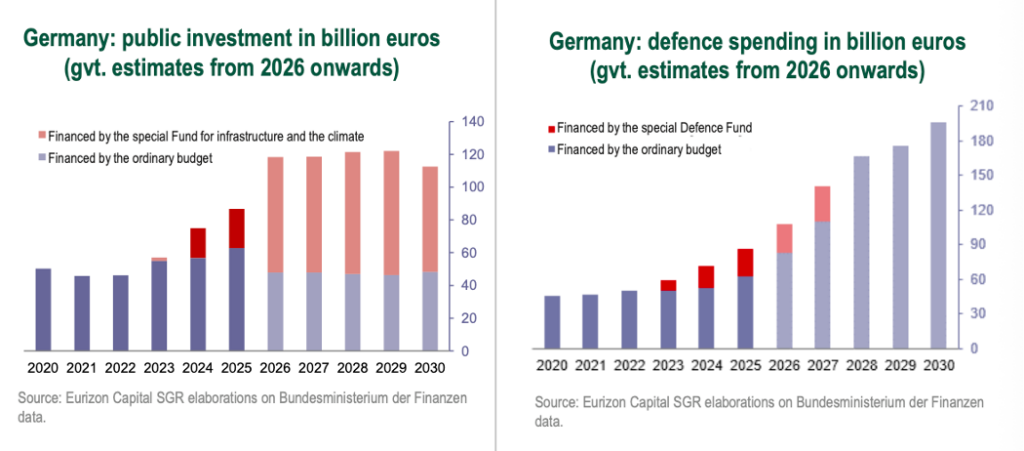
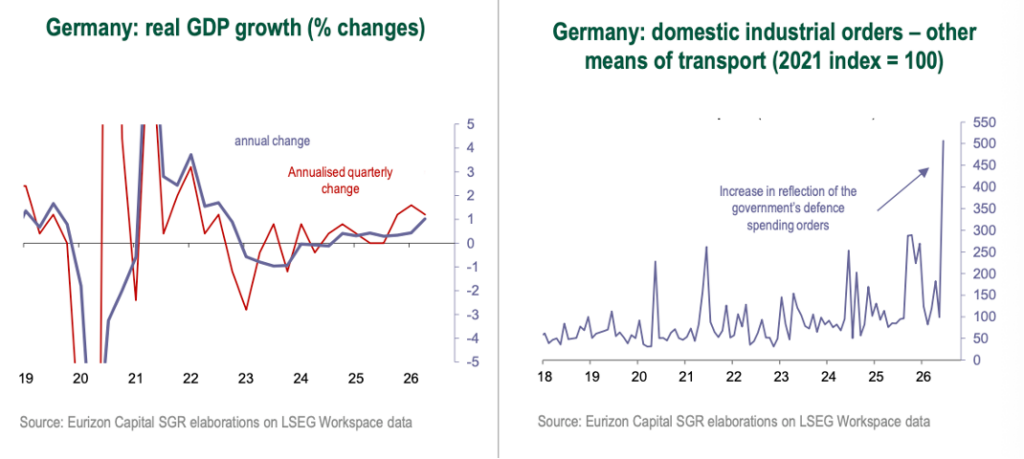
The effect of the measures put in place by the government is evident on the economy: after three years of broad stagnation, GDP growth resumed in the closing quarter of last year.
The recovery continued in the second quarter of this year, despite the rise in energy prices caused by the conflict in the Middle East.
The resilience of economic activity has prompted economists to revise up consensus growth expectations for 2026, after having cut them significantly on fears of the conflict between the United States and Iran having heavier repercussions on the economy.
Growth was mostly driven by public spending, although exports also contributed positively.
Government-driven growth is particularly evident in the infrastructure and civil engineering sectors, as well as in “other means of transport”, where orders surged in reflection of massive public spending appropriations for defence, in the aerospace and shipbuilding segments in particular.
The outlook also remains favourable
While recent data on real activity point to a potential slowdown of industrial activity due to temporary factors, such as the drought which has hindered navigation on the Rhein, the underlying trend is positive for growth.
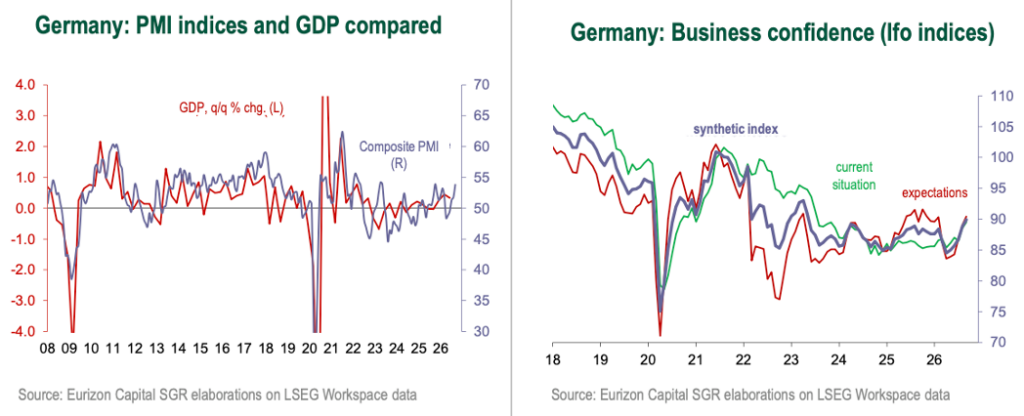
Leading indicators such as those on industrial orders and business confidence (PMIs and Ifo) also improved visibly in the past few months, signalling not only ongoing growth, but a strengthening of the recovery as well, despite the recent, sharp increase in energy prices, and persistent geopolitical uncertainty.
The coalition government led by Merz is betting on this strengthening of growth to contain the loss of support it is experiencing to the advantage of the far-right party Alternative für Deutschland (AfD). At the recent regional elections, the AfD further increased its share of the vote, in particular to the detriment of the CDU.
However, time is on the government’s side, as the next Parliamentary elections are scheduled in 2029.