

 Opinion Leaders
Pe scarcity economy: owning the bottlenecks of global growth
-
Hubert de Marliave
Head of Equities
Gonet
The world economy may have abundant capital and technology. However, the lack of physical resources could hinder global growth.
For much of the past thirty years, investors operated in a world characterised by abundant energy, abundant capital and relatively weak demand for physical infrastructures. That environment is changing significantly. Indeed, numerous different forces are now competing for the same limited resources:
- Artificial Intelligence & Data Centers (DC)
- Electrification of transport, building and industry
- Energy security and reshoring
- Climate adaptation and rising water requirements
The result is not necessarily a global shortage of resources. Indeed, the real scarcity relates to resources available in the right place, at the right time and with the necessary infrastructure. For instance, electricity may be available nationally but unavailable at the location of a proposed DC. Even if power is available, protests by local residents fearing for their electricity supply, may delay the approval for the construction of a DC or even prevent it.
Likewise, copper exists underground, but new mines can require more than a decade to obtain a permit and develop. Renewable energies are growing, but grid connections and transformers are insufficient. Last, critical minerals, especially rare earths, may exist globally but remain concentrated in a small number of countries (Chile, Peru, Republic of Congo, Indonesia, Australia, China, Russia, Canada and the US), adding a potential geo-political aspect.
This creates potential pricing power for companies which own scarce resources, control access to essential infrastructures, manufacture equipment needed to relieve bottlenecks and improve the efficiency with which scarce resources are used. In this article, we highlight some listed companies that are well placed to make the most of the“scarcity economy”, owning the critical resources and bottlenecks of the new economy.
1. Electricity: The essential Resource of the digital economy
Electricity demand in Western economies is growing again after more than a decade of stagnation due essentially to industrial offshoring. Demand growth is back in the US and Europe with DC emergence but also electric vehicles, heatpumps and automation, that all depend on reliable electricity. The IEA expects electricity consumption from DCs toapproximately double between 2025 and 2030. In the US, DCs could represent half of the total electricity demand growth through 2030.
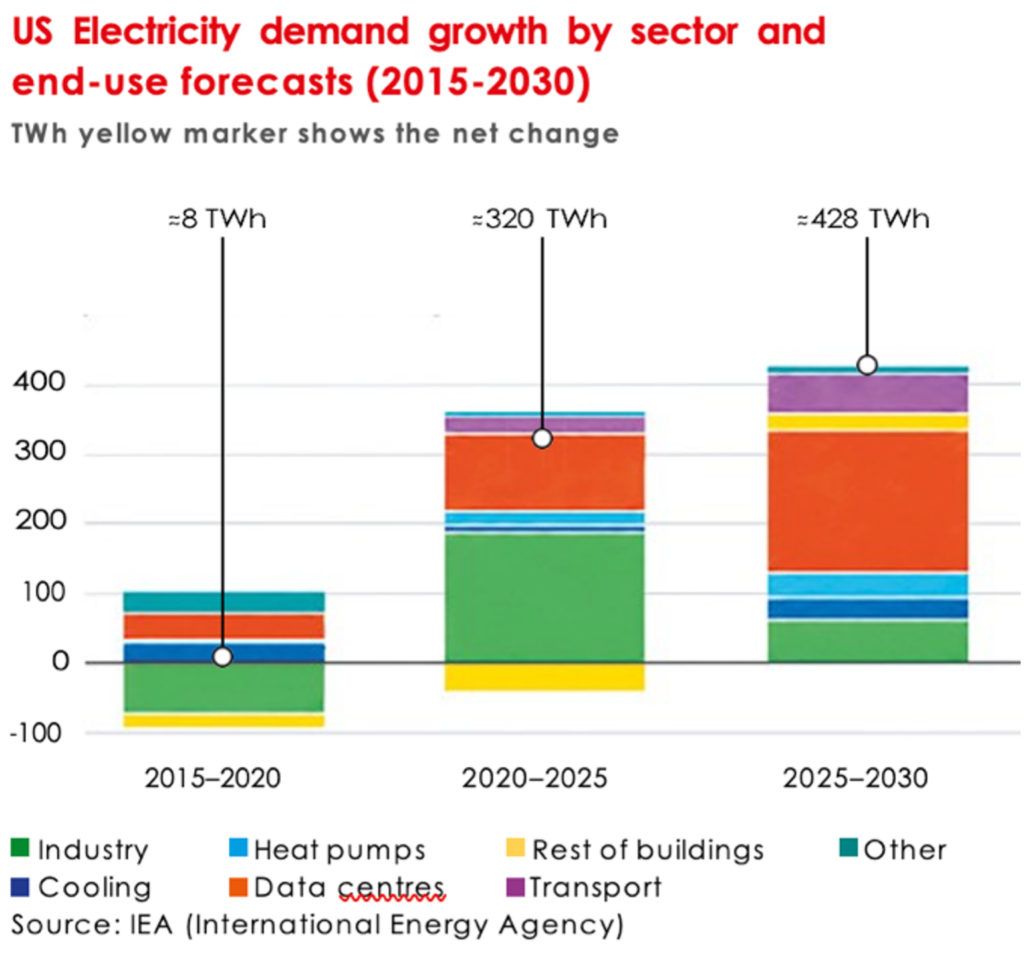
Overall, worldwide electricity consumption is expected to grow 4% per annum by 2030 (Source: IEA). Geographically, China, India and South-East still drive most global volume growth.
2. Potential beneficiaries around the power value chain
Against this background, rising electricity demand creates opportunities across the power supply chain. Indeed, utilitiesneed to add generating capacity and secure reliable power when demand peaks, while equipment suppliers provide the turbines, grid controls and DC systems needed to deliver that power where it is used.
We show below the different segments and some of the relevant companies with the proper offer to respond to this demand.
| Segment | Companies |
| Power generation | Constellation Energy, Vistra, Engie |
| Renewables energy | Iberdrola, RWE, NextEra Energy; Ausrüstungsanbieter: Vestas, Nordex, Ming Yang |
| Gas turbines | GE Vernova, Siemens Energy |
| Energy storage | Energy Vault, Fluence Energy, Infinity Energy; Anbieter grosser Speichersysteme: CATL, BYD, Tesla |
| Power management | Schneider Electric, Eaton, ABB, Siemens |
| Data Center cooling systems | Vertiv, Eaton, Schneider Electric |
The storage segment seems particularly interesting as the expansion of renewable energy requires significant storage capacity, given the intermittent nature of its production (solar and wind). However, at this stage listed pure players haveeither a limited size or are owned by a large group not focused on this business.
3. Beneficiaries around the grid capacity
Generating additional electricity is insufficient if it cannot be transported to where it is needed. The rapid growth of renewable generation, DCs and electrified industrial processes requires: high voltage transmission, distribution grid-reinforcement, substations and transformers, grid management software, high voltage cables, connection equipment and switchgears as well as energy storage and demand management software.
Grid capacity looks as one of the most attractive segments of the scarcity theme as equipment manufacturers canbenefit from higher investments across multiple energy generation technologies without requiring investors to predict which type of electricity production (nuclear, gas, solar of wind) will dominate.
In addition, these players usually boast large order backlogs, high barriers to entry, long customers qualification periods, increasing service revenues as well as pricing power. Noteworthy the presence of Schneider, Eaton, ABB and Siemens whose respective offerings also contribute to the grid revamping beyond power management via their electrification and automation business.
We show below the different segments and some of the relevant companies with the proper offer to respond to this demand.
| Segment | Companies |
| Elektrification and automation | Schneider Electric, Eaton, ABB |
| Grid equipment and turbines | Siemens Energy, GE Vernova |
| Transmission cables | Prysmian, Nexans, NKT |
| Regulated utilities | National Grid, SSE, Eon |
| Elektrical connectors and components | Hubbel, nVent |
4. Critical Materials: Where scarcity meets geopolitics
Copper, lithium, rare earths, graphite, nickel and cobalt are essential to electrification batteries, industrial automation anddefense. They also support DCs expansion, most directly through power infrastructure, back-up batteries and cooling equipment, although the importance of each material varies by application.
Copper stands out because it is widely used in power networks, electric motors and renewable energy production. It is also difficult to substitute and takes a long time to bring into production.
The IEA expects copper demand to grow by around 30% by 2040 under current policy settings. Its 2026 outlook also points to a potential long-term supply gap of 25% despite announced new capacity projects. This is due to higher development costs, limited discoveries and lengthy permitting, constraining new supply.
We show below the different segments and some of the relevant companies with the proper offer to respond to this demand.
| Segment | Companies |
| Copper producers | Freeport-Mc Rohan, Antofagasta |
| Diversified mindes | BHP Rio Tinto, Glencore |
| Rare earths | Lynas Rarte earths, MP Materials |
| Lithium | Albermarle, SQM |
| Uranium | Cameco, Kazatomprom |
| Processing and recycling | Aurubis, Umocore |
| Mining equipment | Epiroc, Sandvik, Caterpillar |
Other materials present different opportunities. Rare earths are important to electric motors, wind turbines and defence equipment, but the constraint is not only the availability of mineral deposits.
Indeed, China accounts for 60% of mined rare earths, and more than 90% of refining. A mine outside China therefore does not by itself create a fully independent supply chain. This explain why there is a lot of bargaining between the US and China as the former is ahead as regards AI technology while the latter is in a position to hinder US production by imposing an embargo on rare earths, refined or not. This concentration gives government and manufacturers a strong incentive to fund alternative refining and recycling capacity.
Other critical materials require a selective approach. Lithium, cobalt and graphite are important to batteries, but their markets have different supply dynamics and can move from shortage to surplus as new capacity arrives.
For the scarcity economy copper seems to offer the clearest broad exposure to rising electricity demand. Rare earths add a distinct strategic angle as the value of secure processing and magnet supply for industries that cannot easily tolerate disruption.
5. Water: Essential, underprices and increasingly constrained
We do not dwell on water in this article as it is widely treated in this CIO Letter. We just indicate in the table below a sample of listed players with a strong involvement in this strategic asset.
| Segment | Companies |
| Water treatment and infrastructure | Xylem, Veolia |
| Industrial water efficiency | Ecolab |
| Pumps, filtration and flow control | Pentair, Sulzer |
| Regulated water utilities | American Water Works, Severn Trent |
| Testing and monitoring | Veolia |
| Descalination and reuse technology | Veolia, Energy Recovery |
6. Conclusion: Different ways of investing in scarcity
Beyond investing in single stocks, ETFs are the safest way to get the right exposure to the scarcity theme. However, being exposed to the wide landscape of the “scarcity economy”, requires to invest in several ETFs as the scarcity economy connects several major investment themes via a single idea: economic growth is increasingly constrained by shortages of physical capacity. These themes include AI, electrification, climate adaptation, sovereignty, energy transition, infrastructures. Scarcity should therefore be used as a stock-selection framework.