
 Focus
Focus
Turn it up
-

Serge Nussbaumer
Chefredaktor
The market for music and live entertainment has been growing strongly for years. The shares of record labels, streaming providers and concert organizers offer correspondingly good entertainment. We take a closer look at this exciting sector and find that there are hardly any alternatives to direct investment in individual “musical” stocks.
Alex Warren is the pop discovery of 2025. The US singer stormed the charts with his ballad “Ordinary”. At the end of July, the catchy tune topped the US Billboard Hot 100 for the eighth week in a row. With a total of more than two billion streaming views, the song made it to the top of the charts in Australia, the UK, Germany and Switzerland. The artist is currently on tour in North America, Hawaii, New Zealand and Australia. This shows that the success is not only ringing in the coffers of Atlantic Records, the US label Warren is under contract to, which is part of the Warner Music Group (WMG). Streaming portals, concert promoters and ticket retailers can also rejoice.
A growth industry
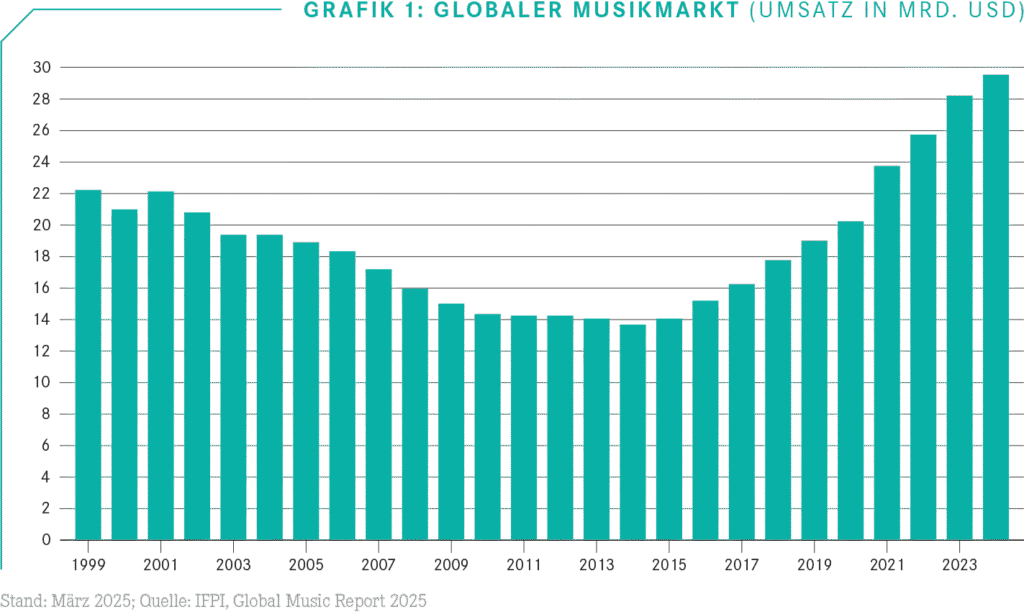
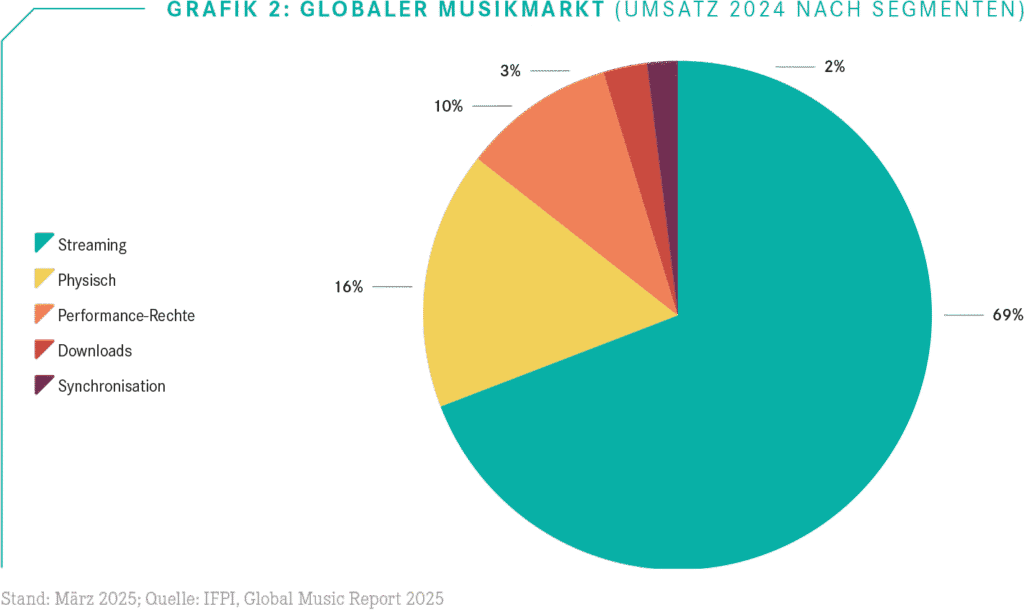
The surprise success exemplifies the diversity and potential of the global music and entertainment industry. Whether pop, hip-hop, heavy metal or classical music – in a world characterized by geopolitical upheaval and diffuse economic prospects, pleasure for the ears is more in demand than ever. “Sales of recorded music have grown consistently for over a decade,” says Victoria Oakley, CEO of the International Federation of the Phonographic Industry (IFPI). For 2024, the industry organization estimates the total revenue of the recorded music industry at just under USD 30 billion. This means that the volume has more than doubled within eight years (see chart 1). The majority of revenue is generated from streaming. In 2024, internet-based music downloads will account for more than two thirds of the total market (see chart 2). “There is great potential for further growth,” says Victoria Oakley, looking ahead.
The top representative of the music labels is also aware of the risks. Oakley refers to the threat of streaming manipulation. This involves creating artificial requests for songs uploaded to platforms and thus generating illegal revenue. “This is theft,” the CEO makes clear. The same applies to the unauthorized use of music for the development of generative artificial intelligence (AI). Here, the association is campaigning for politicians to create a secure legal framework in which AI can develop its potential to support and enhance human artistic creation. Record companies are already working on using this technology to enhance artists’ creativity and develop new and exciting experiences for fans.
UMG: Global music giant
The sector also offers plenty of entertainment for investors. The share price includes record companies as well as promoters and ticket retailers. Universal Music Group (UMG) stands out from the former group. The world’s largest music group brings together legendary labels such as Abbey Road, EMI, Island and Virgin. In 2024, 9 of the 10 most successful artists and bands in the world were under contract with UMG. These include pop queen Taylor Swift, singer-songwriter Billie Eilish and cult rapper Eminem. Spurred on by these and other superstars, UMG is growing strongly. At EUR 11.84 billion, Group sales in 2024 were 60% higher than in the coronavirus year 2020. In the same period, the industry giant increased its operating result (EBITDA) by almost 80% to EUR 2.66 billion.
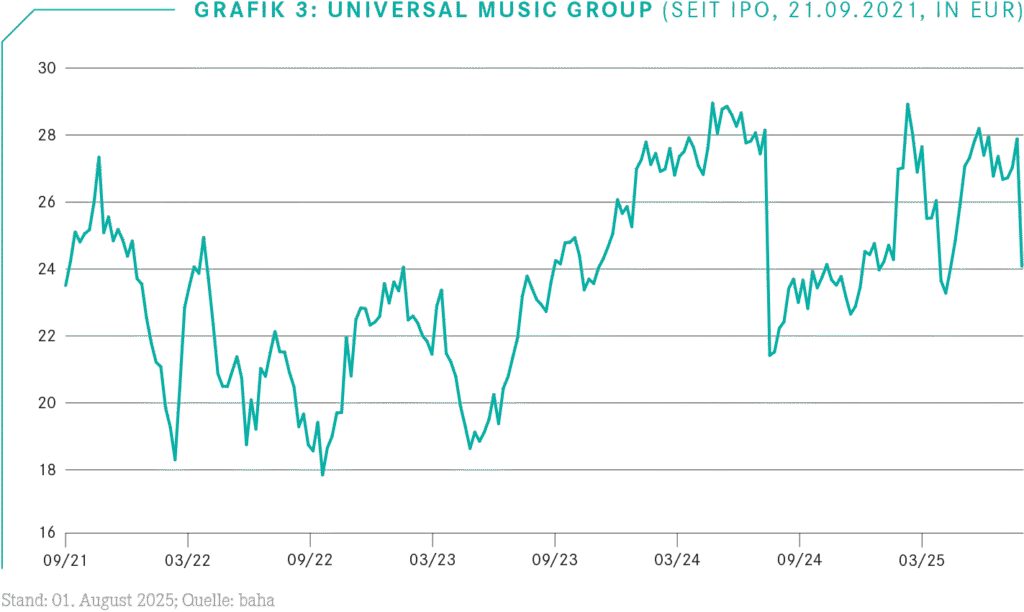
UMG’s momentum has slowed in the current period: For the first half of the year, the company reported sales growth of 6.9% to EUR 5.9 billion at constant exchange rates. In terms of adjusted EBITDA, the Group made disproportionately strong progress of 8.5% to EUR 1.3 billion. Nevertheless, the figures were met with a negative response on the stock market: UMG shares fell by more than 5% after publication. The media stock, which is listed in Amsterdam, had already lost momentum beforehand. In mid-July, the EU Commission expressed its reservations about the planned takeover of Downtown. With the USD 775 million purchase of the label service provider, the UMG subsidiary Virgin could obtain sensitive data from its competitors. The Commission now has until December 10 to examine the case more closely. Unsurprisingly, Virgin does not share the concerns. On the contrary, the company is sticking to its plan to complete the takeover before the end of the year.
Warner Music: In tune with the times
Warner Music Group (WMG) recently attracted attention with a USD 1.2 billion deal. The US group is setting up a joint venture with Bain Capital. The aim of the joint venture is to buy up music catalogs. The two partners have their finger on the pulse of the times with their venture. The interest of financially strong investors in the hits of major artists has been growing for years. Transactions involving the catalogs of Bob Dylan or Justin Bieber, for example, have given rise to an asset class of their own. Last year, Blackstone stepped in and the world’s largest asset manager acquired the music investor Hipgnosis Songs for almost USD 1.6 billion. Investors will find out how WMG’s core business has performed recently on August 7. The company, which is based on Broadway in New York, will then present its figures for the third quarter of the 2025 financial period.
Spotify: A damper as an entry opportunity?
Spotify has also recently caused disillusionment among investors who were euphoric for a long time. Interest in the streaming service remains unbroken. In the second quarter, the Swedes increased the number of premium subscribers by 12% to 276 million, which was more than expected. In total, Spotify recorded almost 700 million monthly active users (MAUs in technical jargon), which corresponds to an increase of 11% compared to the same period last year. However, the company missed the consensus in terms of both revenue and operating profit. On the profit side, the industry giant is in some ways a victim of its own success. The sharp rise in the share price is causing tax charges for share-based remuneration components to skyrocket. In the second quarter, the corresponding social costs more than doubled to EUR 115 million.
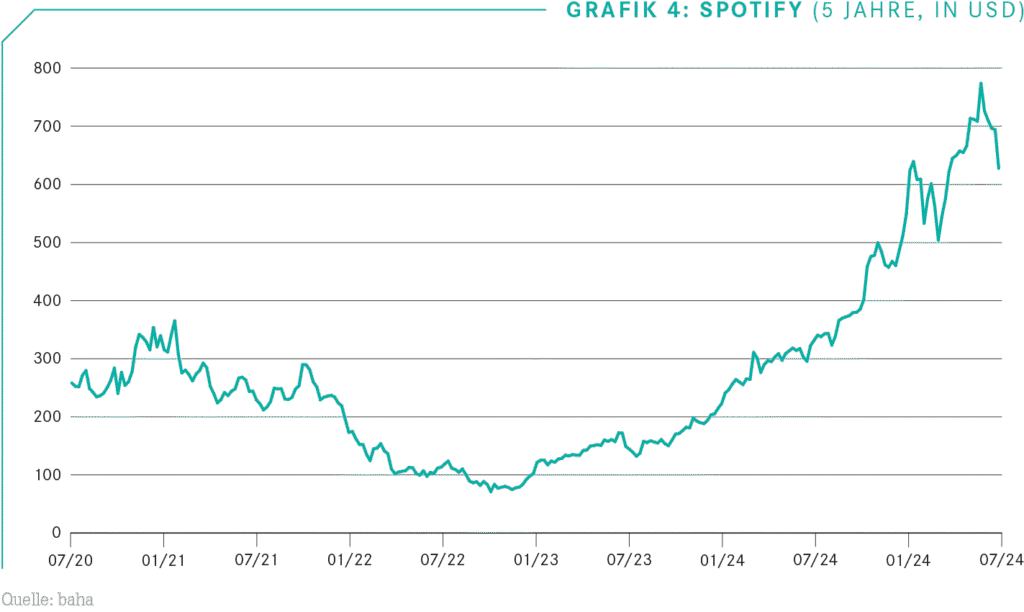
As this burden is also likely to be incurred in the current quarter, Spotify’s earnings forecast fell well short of expectations. On the sales side, the strong euro is clouding the outlook. This does not detract from the strong development in the core business. For the period from July to September 2025, CEO Daniel Ek expects 5 million new premium users. That’s 3 million more than analysts had expected by the deadline. Investors nevertheless cashed in: on the day of publication, Spotify shares in New York plummeted by more than 11%. There could be an opportunity for courageous investors. After all, the Scandinavian company’s drive for innovation is unbroken. With AI-based playlists, a rapidly growing range of video and audio book formats and the ability to access music by voice command, among other things, Spotify is defending its place among entertainment seekers.
CTS Eventim: On the big stage
The digital transformation is also helping the promoter industry. Artists used to generate around 85% of their income from the sale of sound carriers. The remaining 15% came from live performances. “This has reversed today,” said Klaus-Peter Schulenberg in a recent interview. The 74-year-old knows what he is talking about. He is at the helm of CTS Eventim, Europe’s largest concert promoter and ticket retailer. Since going public a quarter of a century ago, Schulenberg has been writing a unique growth story. After the coronavirus pandemic brought the business to a virtual standstill in 2020 and 2021, the Munich-based company picked up even more momentum. Last year, Group sales peaked at around EUR 2.8 billion, almost double the pre-crisis level. In operational terms (EBITDA level), CTS Eventim earned more than half a billion euros in 2024. Although costs rose sharply after the pandemic, especially in the event sector, the company’s EBITDA margin of 19.0% was almost on a par with 2019.
Ticketing profit machine
Speaking of costs: concert fans will still have to dig deep into their pockets. “Prices are rising,” said Klaus-Peter Schulenberg in an interview with the German press agency dpa. His company benefits above all in ticketing. Every year, around 300 million tickets are sold via the CTS systems. Around a third of these are sold via the particularly lucrative online sales channel. Digitalization is and remains a key growth driver. The company uses its immense wealth of data for a targeted and AI-based customer approach. At the same time, Klaus-Peter Schulenberg’s drive to expand is unbroken. “Our activities now extend across Europe, North America and Asia,” writes the thoroughbred entrepreneur in the 2024 Annual Report.
Live Nation: A simple calculation
CTS is thus increasingly entering the Live Nation fold. The US entertainment giant hosted almost 55,000 events with more than 155 million visitors in 2024. More than two thirds of the events took place in North America. The Ticketmaster division sold more than 637 million tickets last year. “2024 was the biggest year ever for live music,” enthuses Michael Rapino, CEO of Live Nation. According to the industry veteran, more artists are on tour than ever before. Looking ahead, Rapino sees internationalization as a major growth driver. In the past, a “world tour” meant that musicians performed in Europe and the USA. “Today, it usually spans five continents with dates in Asia, Australia, Latin America and other countries,” explained the CEO.
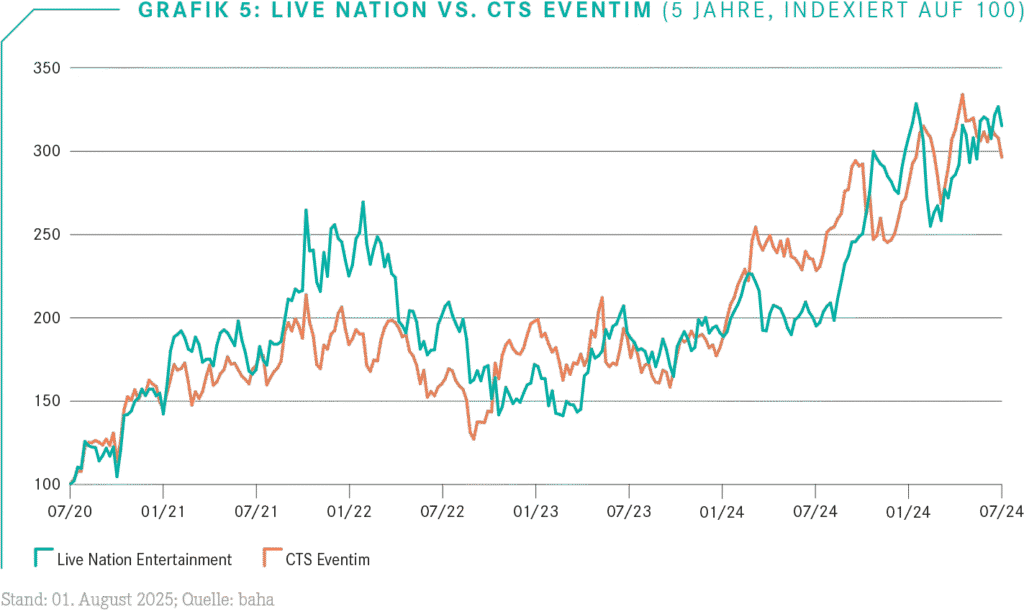
Another accelerator is social media. Rapino has done the math: Top artists reach more than 150 million followers and monthly listeners. If only 2% of them attend a live performance, that would mean the sale of 3 million tickets. “This is impressive proof of how much untapped demand there still is and how much room live entertainment still has to grow,” says Rapino.
Investment solutions
From a long-term perspective in particular, shares from the music and showbiz sector have a lot to offer. The general desire for entertainment meets structural growth drivers such as digitalization, the well-filled wallets of Generation Z or new styles such as K-pop. Unfortunately, there are no opportunities for diversified investment in the sector in Germany. The USA is further ahead: on Wall Street, the Global Music Industry Index ETF MUSQ is listed on Wall Street. The portfolio of this passive fund contains the shares discussed here plus 22 other companies from the sector. These include China’s streaming giant Tencent Music as well as the US technology groups Apple, Amazon and Alphabet, which are also active in this segment.
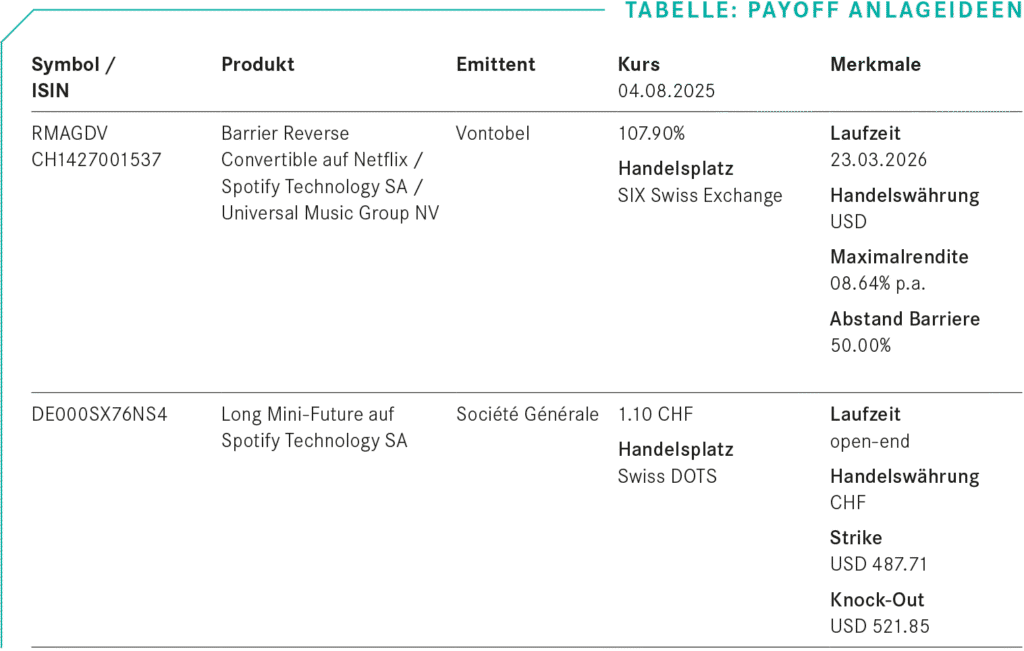
The range of structured investment solutions is also rather thin on the ground. Vontobel has combined UMG and Spotify with Netflix for the Barrier Reverse Convertible RMAGDV together. The product, which matures next March, offers a yield of 8.6% p.a. Prerequisite: none of the three shares falls at or below the barrier. Even the “worst performer”, UMG, has a cushion of around 47%.
Spotify has a firm place as an underlying in the area of leverage products. Société Générale trades on Swiss DOTS, including the mini future with ISIN DE000SX76NS4. This bill currently participates in rising prices of the streaming giant with a leverage of 5.1. Investors with an affinity for trading can use this security to bet that the correction at Spotify – similar to previous setbacks – will soon come to an end. But beware: if the share falls out of favor for a longer period of time, there is a risk of disproportionately high losses.