
 Focus
Focus
Actively Managed Certificats: Between Boom and Regulation
-

Wolfgang Hagl
Redaktor
Actively Managed Certificates (AMCs) open access to a wide variety of asset classes. Compared with classic investment funds, these vehicles can be launched quickly and cost-effectively. Consequently, Actively Managed Certificates have gained significance in recent years. In the middle of this success story, FINMA is issuing a warning. We take a look at the world of AMCs and present some promising products.
The Swiss market for Structured Products is basking in sunshine. In 2025, industry turnover rose by 18% to CHF 235 billion. Growth accelerated in the first three months of the year: at CHF 79 billion, revenues were 27% above the level of the same period last year. These figures fit the exuberant mood at the 20th anniversary party of the Swiss Structured Products Association (SSPA). On 11 June 2026 the industry association celebrated its 20th birthday. Among the guests at Lux, the restaurant of Zurich’s Kongresshaus, was Zeno Staub. The former CEO and current board member of Bank Vontobel is a pioneer of the sector. More than 30 years ago, as an intern, he was part of a team that issued the second Structured Product ever listed on the Swiss market. Under the title “A Track Record of Innovation”, Staub honoured the achievements of this special industry and its association on the shores of Lake Zurich.
FINMA, the Swiss Financial Market Supervisory Authority, very nearly became a killjoy. A few days before the SSPA event, FINMA published its Supervisory Communication 03/2026. In it, the regulator addresses the “risks of using products in individual portfolio management”. FINMA was prompted to act by “a sharp rise in cases escalating due to deficiencies.” In addition to foreign funds, affected asset managers had also placed Structured Products – in particular AMCs – into client portfolios. AMC stands for Actively Managed Certificate. To be clear: the rebuke – with the regulator referring to losses that were in some cases substantial – is not aimed directly at the providers. Rather, the regulators request more diligence with regard to suitability assessment, risk disclosure and management of conflict of interests. Nonetheless, the FINMA statement had an effect on issuers. They fear damage to the reputation of their most important growth generator.
Blossom in the niche
In order to understand the ins and outs of an AMC, the definition given by the SSPA helps to clarify: “Certificates which are based on a dynamic strategy and which require active management. The composition of the basket of underlyings may change during maturity in accordance with specified investment guidelines and the title universe”, the industry association writes in a glossary. The direction is clear. With the AMC, providers of Structured Products are venturing into the territory of active asset managers and traditional investment funds. The initiators were less concerned with attacking the billion-heavy fund giants; rather, Actively Managed Certificates were able to blossom in the niche.
It works in their favour that active investment strategies can already be implemented with smaller investment amounts. Issueing a fund involves enormous administrative effort. As collective investment schemes (KAG), funds are strictly regulated. In addition to the fund company itself, a custodian bank, ongoing reporting and an auditing firm are required. The approval process can take months and only makes sense if the fund records significant inflows. An AMC, by contrast, can can be launched within days or weeks, with comparatively low issuing costs. According to experts, strategies with assets under management (AuM) below USD 100 million can achieve a cost advantage of 60% to 70% over the entire lifecycle compared with comparable fund structures.
Of course, this advantage should not hide key differences to a fund. From a legal point of view, Structured Products are bearer bonds, not collective investment schemes (KAG). Unlike with a fund, the investor is therefore exposed to the default risk of the respective issuer. And naturally, the regulatory discrepancy can also lead to a certain degree of lack of transparency – the FINMA warning is not unfounded. More than ever, investors in this market segment need to pay attention to the details and, above all, understand the underlying strategy.
A broad spectrum
The great flexibility of AMCs has led to a steadily growing range of products. While equities were initially the focus, the spectrum has since expanded across other asset classes over time. Commodity and bond strategies can be implemented in this format just as well as private equity, infrastructure or real estate. And of course, the advance of AMCs has not stopped at the world of cryptocurrencies either. In this way, a considerable market has emerged. However, there are no specific and reliable figures available regarding the total amounts invested. One estimate comes from the United Kingdom. According to the UK-based financial boutique Orpheus Capital, the global AMC market is worth around USD 1.6 trillion, of which Swiss asset mangers account for roughly USD 300 billion.
Given the wide selection of AMCs, it is not entirely easy to keep track of the big picture or to find the right investment solutions. The payoff magazine went in search of promising products. We limited ourselves to exchange-listed AMCs – liquid trading is of central importance – as well as to equity products.
The DW Global Resource Efficiency Index Portfolio has a relatively long history. Introduced back in 2013, Julius Bär wrapped this strategy into AMC form in September 2017. DuraWealth AG acts as portfolio manager. The asset manager, based in the Principality of Liechtenstein, seeks out companies committed to a transition towards more effective resource use.
The portfolio, currently containing 30 individual holdings, is dominated by technology titels such as US semiconductor maker Micron. However, the selection also includes broadly positioned industrial groups, including Siemens. The performance is respectable: since issuance, the AMC has achieved an average annual return of nearly 15%. This represents outperformance of more than 7 percentage points per year versus the benchmark, the global equity barometer MSCI All Country World. However, it is notable that the certificate decreased more sharply in value during weak market phases than the comparison index, which comprises more than 2,500 stocks.
Searching for momentum
This pattern can also be observed in the Allegro Portfolio. Nevertheless, the strategy implemented by Southern Rock Capital also shows a solid outperformance. Almost two years ago, UBS issued an AMC on the Allegro Portfolio. Relative to the issue price, the value of the Structured Product has roughly quadrupled. At the core of the strategy is a factor-based approach: those responsible look for titles showing robust price momentum. They rely on a combination of data analysis and in-house research to achieve optimal holding periods.
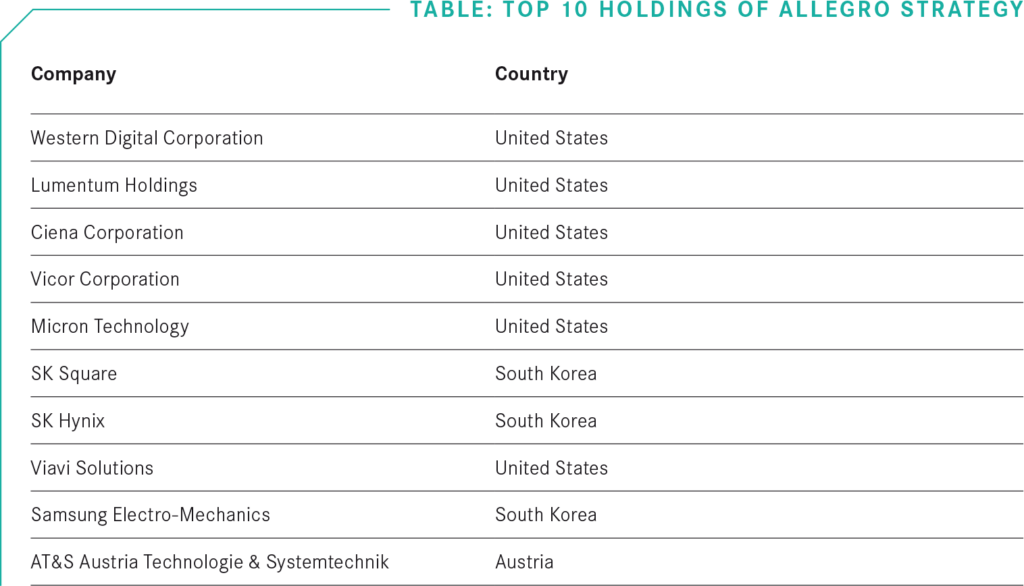
Most recently, the strategy benefited from a high technology weighting, with nearly three-quarters of the portfolio invested in IT titles in May 2026. Heavyweights included storage specialist Western Digital and semiconductor company Micron. With Austrian chip group AT&S, a European name is also among the Allegro Strategy’s top 10 positions (refer table “Investment Recommendations”). Overall, only 14 titles were in the portfolio as of the reporting date. This thin composition also explains the AMC’s high volatility. Annualised, the product shows a price fluctuation range of nearly 50%. Only investors who can cope with sharper shifts in prices should therefore consider entering here.
A prolific idea generator
Leonteq offers a large range of AMCs. The Zurich issuer’s platform features more than 120 such products. As a listed company, Leonteq also provides insight into its success. As of the end of 2025, the company estimated outstanding AMC volumes at CHF 2.3 billion. In the second half of last year, this business generated recurring income of CHF 28.3 million. For numerous Leonteq AMCs, Swissquote acts as an idea generator and portfolio manager. Among other things, the direct broker’s strategists are responsible for the Swissquote Hydrogen Index. For more than six years, this AMC has brought together global hydrogen companies.
After a successful start, the strategy turned downward in early 2021. Most recently, this theme has celebrated a comeback (refer Chart 1). Not least the power demand associated with establishing and expanding AI is making fuel cell technology attractive again. The Solactive Hydrogen Index includes several pure plays such as the North American duo Ballard Power and Plug Power, alongside broadly diversified industrial groups devoted to this topic relevant for the future – for example Air Liquide, the French industrial gases specialist, which also produces hydrogen.

Swiss favourites
Bank Vontobel relies on the expertise of its in-house research department for the Top Swiss Selection of the Year Basket. At the start of each year, this AMC brings together the analysts’ favourites. The investment universe matches Vontobel’s coverage and comprises around 130 companies. To qualify for inclusion, a given title must have at least a “hold” rating, ideally a “buy” recommendation. As soon as Vontobel downgrades a basket member to “sell”, the title in question is removed from the basket, and the freed-up funds are distributed amongst the remaining titles. At mid-year 2026 the basket still matches its starting line-up.
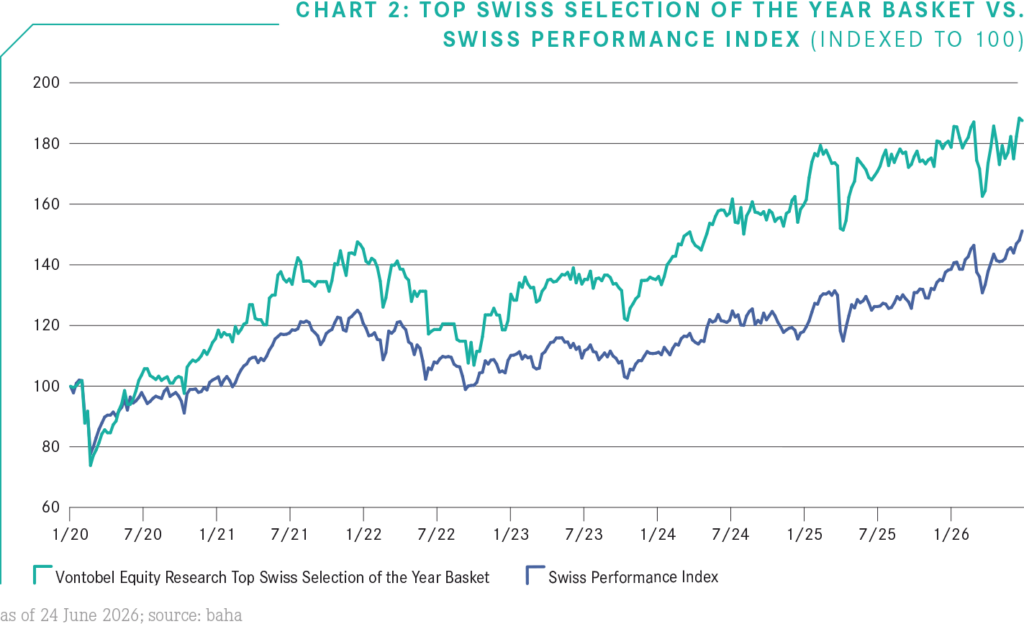
As it turned out, Partners Group was slowing things down in the first half of the year. Problems with so-called evergreen funds caused the investment firm’s market capitalisation to shrink by around a third. The Vontobel experts, by contrast, scored a hit with VAT Group – the shares of the semiconductor equipment maker rose by more than 70% in the first half. While the basket as a whole lagged behind the broader market so far this year, it still shows a solid outperformance of around 36 percentage points versus the SPI since the AMC’s launch (refer Chart 2). This shows that investors in such active strategies should not bet on quick profits. Rather, a “buy and hold” approach makes sense.