

 Opinion Leaders
AI value chain: Asia continues to play a key role
-
Dina Ting
CFA, Head of Global Index Portfolio Management
Franklin Templeton -
Marcus Weyerer
CFA, Director of ETF Investment Strategy
Franklin Templeton ETFs
The topic of ‘AI investment’ cannot be confined to a single country. Understanding the geographical landscape can be just as important as the scale of the sector itself.
Taiwan, for example, continues to play a central role in the manufacture of advanced semiconductors, whilst South Korea and Japan are also indispensable in their own ways. Each country occupies a different position within the AI value chain and the AI ecosystem. This differentiation is underpinned by ETF inflows. Although Asia as a whole has recorded net outflows this year, these are mainly attributable to outflows from China.
Furthermore, the valuation differences between the US and international markets can now hardly be ignored. Although the S&P 500 has posted price gains in 2026, it is currently trading at around 22 times expected earnings. The European market, by contrast, has a price-to-earnings ratio of around 16.1 This discrepancy, combined with improved earnings forecasts, presents international markets with an opportunity to narrow the valuation gap.
These regional differences are exacerbated by diverging monetary policies. Whilst some central banks are continuing to tighten monetary policy, others have paused or have already begun to ease. This is leading to increasingly divergent macroeconomic conditions across individual countries.
Midyear 2026 Consensus Expectations
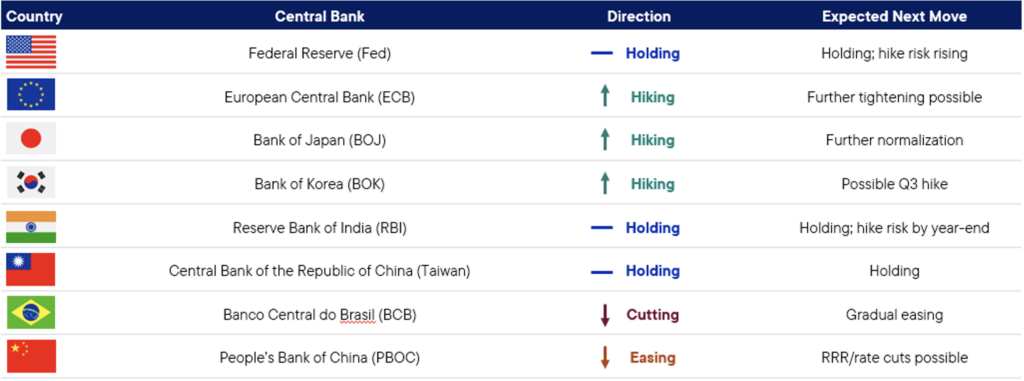
As synchronised monetary policy is increasingly being replaced by country-specific cycles, targeted allocations may present greater opportunities for investors than a broadly diversified geographical exposure.
China: Looking beyond short-term headlines
China continued to underperform in the first half of the year, recording a decline of over 13 per cent. This was due to continued subdued domestic demand and the ongoing drag on market sentiment from the property sector. Nevertheless, based on expected earnings, the market is currently trading at a price-to-earnings ratio of around 11.4 – well below the long-term average2. This suggests that significant economic and geopolitical uncertainties are already factored into valuations.
Importantly, the investment case is evolving beyond mere valuation criteria. China continues to channel capital into advanced manufacturing, artificial intelligence, semiconductors and strategic technologies. At the same time, the country is expanding its investment in scientific research and higher education. It now produces significantly more graduates in STEM subjects each year than the US. It has also emerged as one of the world’s leading centres for cutting-edge scientific research. Although geopolitical tensions continue to pose a significant risk, current valuations appear to be increasingly detached from China’s innovation potential. For long-term investors who are prepared to look beyond short-term headlines, we consider the risk-return profile to be thoroughly attractive.
Brazil outperforms the S&P 500
The Brazilian share index, which is characterised by a very different sector composition, delivered a return of 13.3% in the first half of 2026, outperforming the S&P 500. The financials, commodities and energy sectors contributed significantly to the market’s strength and illustrate that market leadership is increasingly shifting from AI infrastructure to more cyclical and value-oriented sectors. As the inflation figures for June came in slightly below expectations, the markets anticipate greater scope for further monetary easing as the year progresses. This could provide further support for domestic demand and sectors that are more sensitive to interest rates. Although fiscal discipline remains an important factor to monitor, the combination of attractive valuations and cyclical tailwinds could continue to set Brazil apart from other emerging markets.
India: GDP growth of 6.4% expected for 2026
India’s performance in the first half of the year was rather mixed, and given the high market valuations, there is less scope for disappointment. However, the country’s long-term structural prospects remain intact. These are underpinned by favourable demographic trends, the expansion of digital infrastructure and sustained investment in the manufacturing sector. Performance across individual sectors has been mixed since the start of the year: the utilities, industry and healthcare sectors made a positive contribution, whilst the information technology and energy sectors had a negative impact.
After several years of holding a leading market position, India remains one of the more expensive emerging markets. Ongoing infrastructure development is strengthening the country’s position within global supply chains, and the International Monetary Fund continues to forecast that India will be among the world’s fastest-growing major economies. Gross domestic product growth of 6.4 per cent is expected for 2026.3
Asia: The AI infrastructure sector is expanding
Asia continues to play a central role in the next phase of the AI investment cycle, but the situation has now become more complex. The advice to ‘buy semiconductors’ alone is no longer sufficient. Whilst artificial intelligence technologies continue to dominate returns, developments in the first half of the year suggest that the benefits are increasingly spreading to related sectors and domestic economies.
The broader market in Taiwan recorded a rise of almost 70 per cent in the first half of 2026, driven predominantly by the technology sector. This sector accounted for around three-quarters of the index weighting and the lion’s share of absolute returns.4 The financial sector also made a positive contribution, whilst the consumer staples and utilities sectors recorded moderate gains. This suggests that AI-driven investment is increasingly generating broader economic momentum beyond semiconductor manufacturing.
South Korea led the way with a return of 101 per cent in the first half of the year. The IT sector made by far the largest contribution. However, the industrial and cyclical consumer goods sectors also recorded significant gains, as investment in AI infrastructure expanded beyond memory chips to include manufacturing equipment, automation and the entire supply chain. The recent enthusiasm among investors for the South Korean technology ecosystem – evident, amongst other things, in the exceptionally high demand for the US IPO of a leading memory chip company – underlines the continuing confidence that the expansion of AI infrastructure remains at an early stage.
Japan’s experience illustrates a different form of market expansion. The market achieved a return of around 15 per cent. However, the gains were spread across the financials, industrials, materials and technology sectors, rather than being concentrated in any single sector. In our view, this reflects not only AI-related investments, but also the ongoing effects of corporate governance reforms, shareholder-friendly measures and renewed investment in advanced manufacturing technologies. Taken together, these markets illustrate that the next phase of AI is likely to be shaped less by a handful of technology leaders and more by an increasingly global ecosystem of companies that develop, operate and enable the underlying infrastructure.
__
1Source: Bloomberg, 8 July 2026. S&P 500 Index and STOXX Europe 600 Price Index.
2Sources: MSCI China Index, Bloomberg. 10 July 2026.
3Source: International Monetary Fund’s updated World Economic Outlook. 8 July 2026. There is no guarantee that forecasts, estimates or projections will prove to be correct.
4Source: Bloomberg. As at 30 June 2026.