
 Opinion Leaders
Hormus is driving up oil prices – but a supply surplus looms in 2027
-
Investmentview Eurizon
Solid and stable growth in the US, weaker but positive in the Eurozone.
Inflation slowed in June, but the new closing of the Hormuz strait may halt its decline. The money markets are pricing in, for both the ECB and the Fed, one rate hike by the end of the year and another in 2027.
Government bonds are proving volatile due to oil price fluctuations but remain appealing thanks to coupon flows in excess of forecast medium-term inflation. Spreads little changed as geopolitical tensions rise back, and still a source of additional return on top of government bonds.
Geopolitical tensions are still the main factor supporting oil prices in the near term, although the war in the Persian Gulf has effectively changed medium-term market balances, paradoxically creating the conditions for a future structural increase in supply starting in 2027, a prospect that is helping keep prices under control.
Oil: Hormuz and 2027 supply surplus
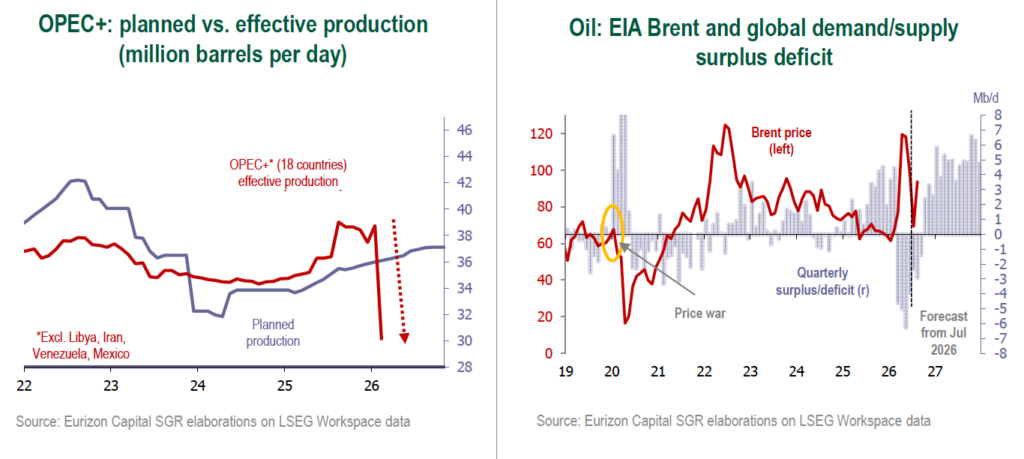
OPEC+ is undoubtably being weakened by the US-Iran war. On 1st May 2026, the United Arab Emirates left the cartel, shedding themselves of the quota system. Subsequently, Iraq also declared its intention to step up production, threatening to leave OPEC if its requests are denied.
The blocking of oil supply flows through the Persian Gulf acts as a strong incentive to step up production in all exporter countries not forced to use the Hormuz route (both part of OPEC+ or not). Production data for June, despite partial traffic transit through the strait, confirmed this dynamic, with many OPEC+ countries raising output to levels higher than the quotas assigned to them.
In this context, Saudi Arabia will be prevented from exercising its role as the “oil market central bank” at least until market conditions get back to normal. The Saudis can count on substantial spare capacity at very low production costs and could therefore start a price war (as was the case in 2020) to remodel the market to their advantage. However, given the physical impossibility of exporting oil in the present phase, this course of action is not currently viable.
In the near term, oil prices are likely to remain volatile, particularly as OECD commercial stocks continue to stay at relatively low levels, limiting the market’s ability to absorb any further supply disruptions.
One important source of downward pressures, however, is represented by China, whose demand in recent years has become flexible, acting as a counterbalance to market excesses. Above USD 80 per barrel, China drastically reduces its purchases to the point of influencing oil prices and curbing price increases. From March to June 2026, monthly Chinese imports of oil plunged by 51%.
Net of all these factors, the market is still embracing a normalisation over the next 6 to 9 months as the likeliest scenario, with currently frozen supplies adding themselves to the higher production levels of OPEC+ and other countries.
Forecasts point to the formation of surplus supply worth around four million barrels per day (mb/d) in the spring of 2027; however, for the time being the supply countershock will remain a distant prospect, save for a significant de-escalation of the conflict.
Scenarios
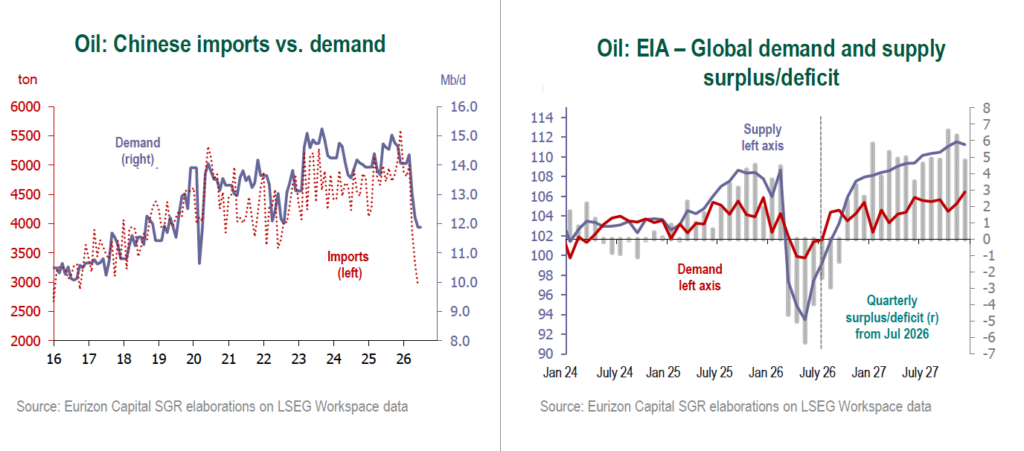
• Less than USD 50 – US shale oil suffers, the USA pressures Saudi Arabia to cut production. Real risk of a price war as a Saudi response to win back market shares.
• From USD 50 to 65 – China purchases aggressively to increase its stocks (a strategy it has pursued since the post-Covid reopening).
• From USD 65 to 80 – The equilibrium range within which the main upward and downward pressures are neutralised: the range inside which the oil price moved throughout 2025 and for most of 2024.
• From USD 80 to 100 – All producer countries make strong gains, also in terms of fiscal breakeven, but China stops oil purchases to generate downward pressures on prices (as was the case during the shop reduction of imports).
• Over USD 100 – Gasoline prices in the US rise above 4 dollars per gallon, resulting in a loss of political consensus, feared by every US administration in office, that usually acts at the global level in response, to obtain production increase. Tangible risk of an impact on global growth beyond this level.