
 Focus
Crypto between Thaw and Turning Point
-

Wolfgang Hagl
Redaktor
The ice is melting, but the rules of the game have changed. Institutional capital flows are driving the recovery of Bitcoin, while Washington has yet to deliver regulatory clarity. In addition, the historical four-year cycle is being put to the test. It remains to be seen whether the new demand base will hold up in a more difficult market environment.
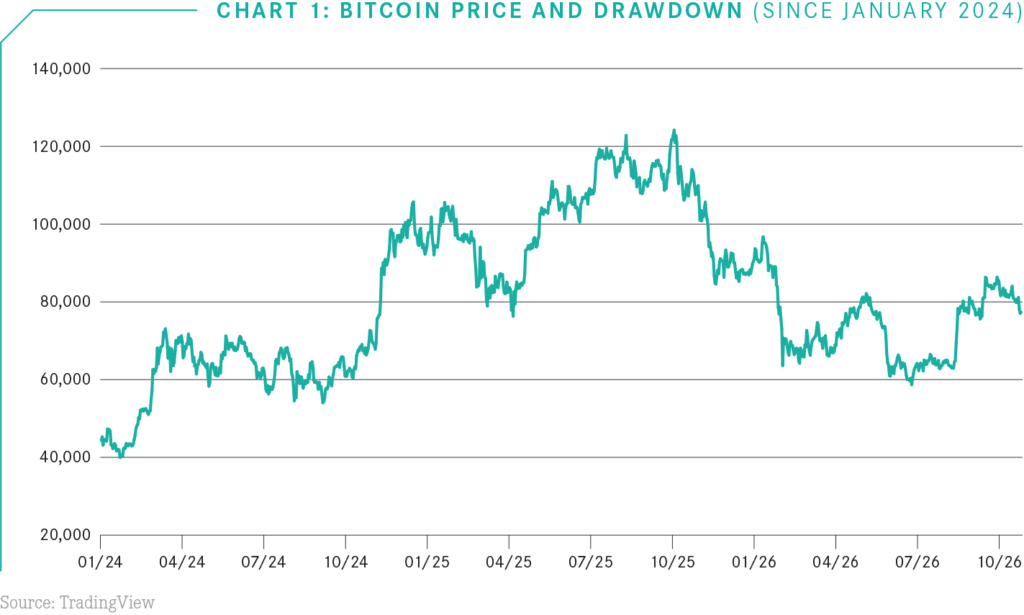
The latest crypto winter began after the record high of USD 126,080 on 6 October 2025. By the end of June 2026, Bitcoin had fallen to around USD 58,000. The loss of 54% corresponds to a pronounced bear market but was smaller than in previous cycles, in which losses at times exceeded three quarters. Bitcoin expert Dieter Haas already documented the development and historical classification of the crypto winter in detail in the ETP & Indexing Guide as of 31 July 2026. Since then, however, the market picture has changed considerably. Bitcoin gained 42.7% in the 3rd quarter. At the same time, US Spot Bitcoin ETFs recorded net inflows of USD 6.36 billion, after outflows of almost USD 5 billion in the previous quarter. The reversal in capital flows provided an important impetus for the recovery. Nevertheless, Bitcoin is still trading around a third below its all-time high. The figures point to stabilisation but do not yet allow a clear conclusion about a new bull market. A strong price rise after a loss of more than 50% can mark either the beginning of a new uptrend or a pronounced countermovement within a longer-term bear market. Therefore, the question of who is buying Bitcoin today and how sustainable this demand is matters more than price performance alone.
Institutional Demand Is Changing Market Mechanics
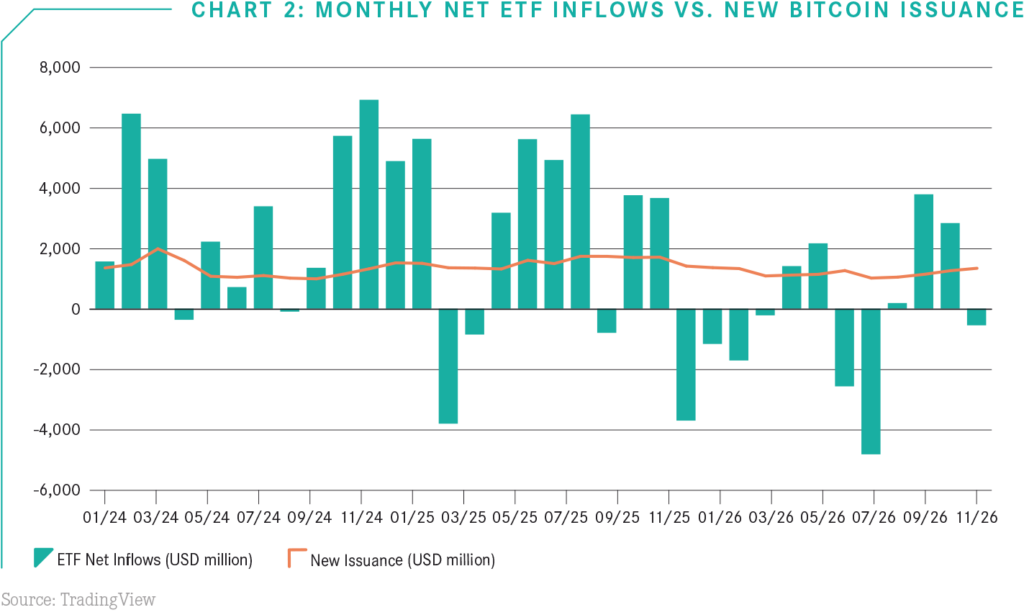
First things first: with the approval of US Spot Bitcoin ETFs in January 2024, the market structure in the crypto world changed fundamentally. Institutional investors can acquire Bitcoin through their existing securities accounts without having to build their own custody or trading infrastructure. This in turn lowers operational hurdles and broadens the potential investor base. However, ETF inflows should not be equated with long-term institutional portfolio allocations. Alongside asset managers and strategic investors, hedge funds use the products for arbitrage trades, in particular to exploit price differences between spot and futures markets. Such positions can be unwound quickly if financing costs change. In addition, ETF inflows do not necessarily translate into an equally large additional net investment in Bitcoin at the level of the overall market. Secondary market trades and hedging transactions can change the economic effect. The order of magnitude is nevertheless relevant. Since the halving in April 2024, around 450 new Bitcoins have been created every day. At a price of USD 80,000, this corresponds to a theoretical new supply of USD 36 million per day. Even moderate daily ETF inflows can fully absorb this new issuance. However, this does not automatically lead to a price increase, as the supply actually available is determined much more by existing Bitcoin holders. The strategists at Wells Fargo share this view. Since almost 97% of all Bitcoins that will ever be available will already have been mined by 2028, demand, institutional adoption and the macroeconomic environment are, in their view, becoming more important for price formation. Coinbase CEO Brian Armstrong, however, takes a contrasting position. He expects an upward trend over the next one to two years on the way to the next halving.
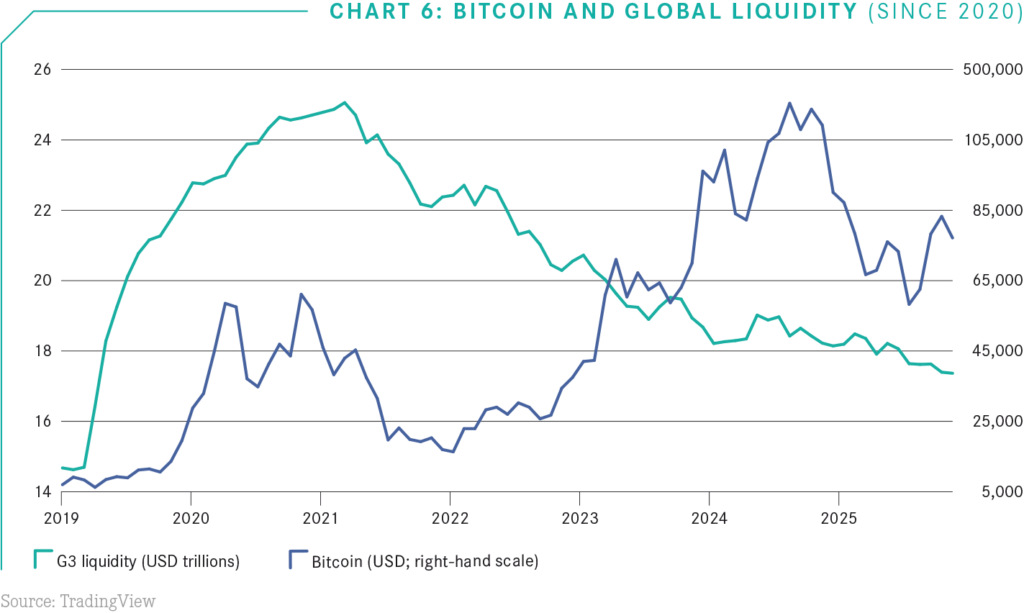
While the explosive power of the halving is open to debate, Bitcoin and other cryptocurrencies are increasingly responding to global liquidity conditions, real interest rates and general risk appetite. Falling financing costs and expansionary monetary policy can boost demand, while rising real interest rates or liquidity shortages lead to selling pressure. As a result, institutional integration reduces certain operational risks but does not eliminate volatility. In periods of stress, volatility can even be amplified if institutional investors have to reduce positions or unwind leveraged strategies at the same time. Therefore, the notion that a broader professional investor base inevitably leads to a more stable Bitcoin market is open to doubt. While it improves market depth under normal conditions, it can also create new transmission channels for shocks from traditional financial markets.
The Four-Year Cycle Put to the Test
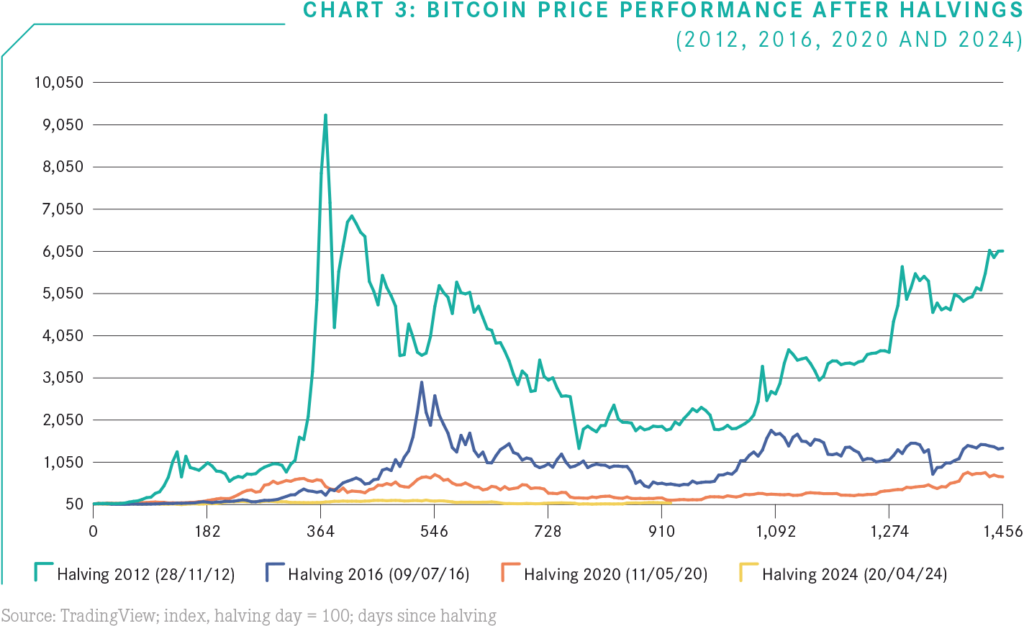
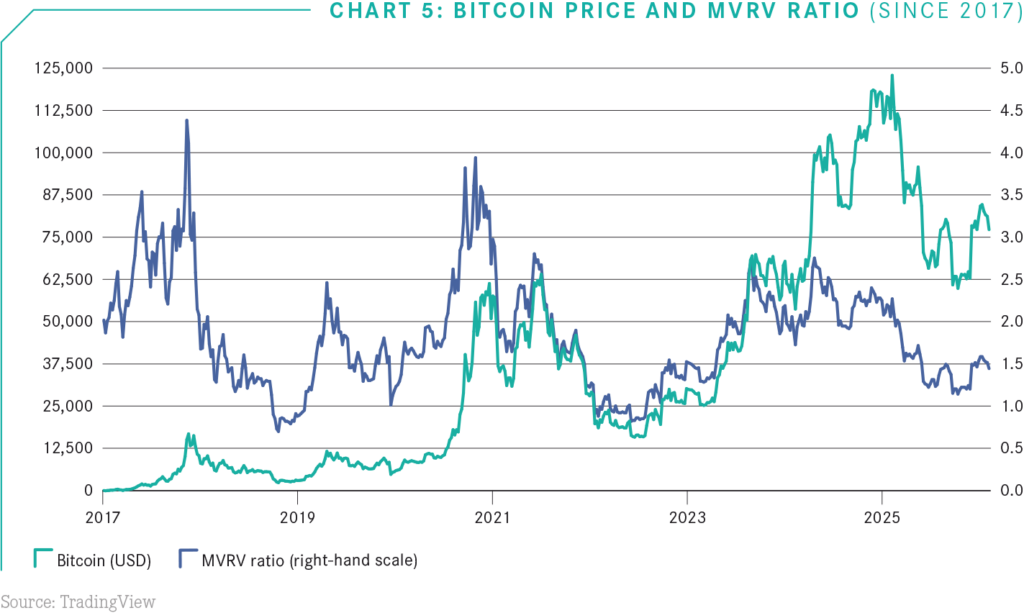
Historically, Bitcoin has moved in a recurring pattern. The halving was followed, with a time lag, by a strong bull market and then by a pronounced correction. Extrapolating this pattern would suggest a cyclical low in the 4th quarter of 2026 following the peak in October 2025. However, the strong recovery since the end of June calls this thesis into question. The clear price reaction and the return of positive ETF flows suggest that a bottom has already been reached. Arguing against an all-clear is the still considerable distance from the all-time high. According to Bernstein, though, the peak will soon be within reach again. The team led by Gautam Chhugani expects a price of around USD 125,000 by the end of the year in its base case. The climb is set to continue beyond 2026: the target is USD 150,000 by mid-2027, with the cycle peak of around USD 300,000 to be reached in 2029. Bernstein sees the so-called “debasement trade”, i.e. demand for scarce assets in view of high government debt and possible currency debasement, as additional support.
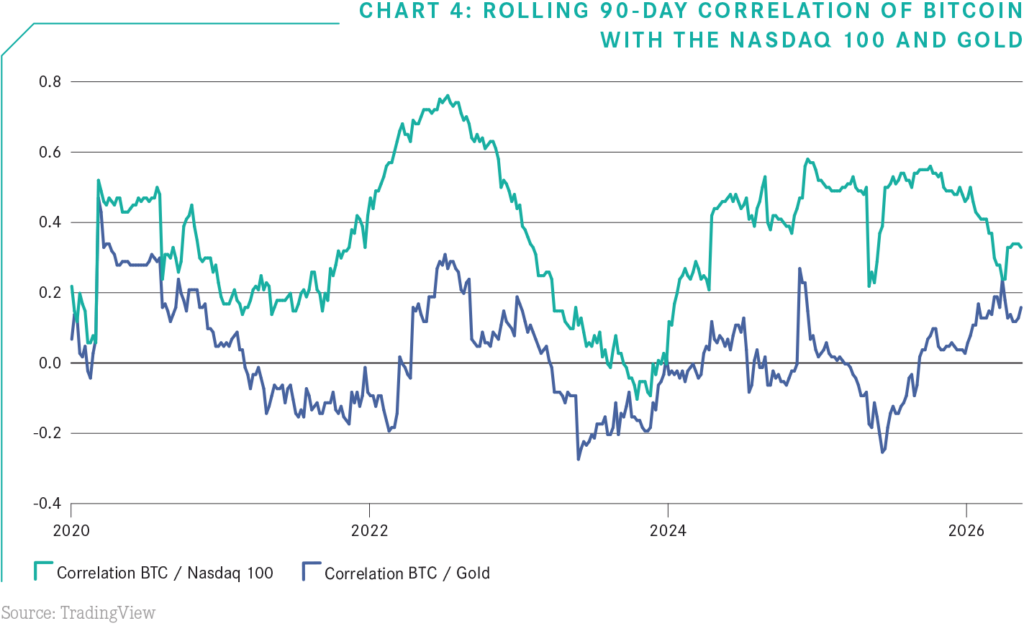
Back to the four-year cycle. It would be premature to declare it irrelevant. The historical data covers only a few complete cycles, and previous patterns are hardly statistically robust. In addition, investor expectations influence market behaviour. If enough market participants expect a cyclical low in the 4th quarter, corresponding positioning can partly reinforce the pattern itself. A sustainable bottom would be more convincing if the recovery were supported by a broader demand base and Bitcoin also showed relative strength in weaker share markets. This confirmation is still lacking. The recovery could equally well be no more than an interruption of the overarching correction. Many crypto experts, however, will have none of it. Like Bernstein, Citi also sees the oldest and largest cryptocurrency on its way back into six-figure territory. In early October, the bank raised its 12-month target for Bitcoin from USD 82,000 to USD 113,000, citing renewed ETF inflows and improved activity in the crypto market. The bank expects net inflows of around USD 5 billion over the next 12 months.
Bitcoin between Digital Gold and Risk Asset
A long-term investment thesis for Bitcoin rests on its limited supply of a maximum of 21 million units, its global transferability and the possibility of holding assets independently of individual state issuers. However, even though these characteristics set Bitcoin apart from traditional currencies, they do not establish a directly calculable fundamental value. Bitcoin generates no cash flows, carries no contractual right to repayment and cannot be valued using conventional discounted cash flow models. Ultimately, its market value depends on the demand for a scarce, decentralised digital asset. This demand may grow over the long term, but it is not guaranteed. The frequently used label “digital gold” also needs to be qualified. Gold has a monetary history spanning thousands of years, established central bank demand and comparatively low volatility. While Bitcoin is subject to a stricter limit on supply, it has a much shorter history and significantly greater price fluctuations. In periods of stress, Bitcoin has so far often behaved more like a highly volatile risk asset than a stabilising portfolio component.
Therefore, for institutional investors, the potential benefit lies less in short-term hedging than in a long-term, asymmetric investment opportunity. The potential for Bitcoin to gain further importance as an asset class in its own right is offset by a considerable probability of loss. Whether this asymmetry is attractive depends largely on the entry price, position size and investment horizon. As already shown, the mathematically limited supply alone does not guarantee an increase in value. Scarcity only unfolds its economic value if there is sufficient and lasting demand. At the same time, the lack of a cash flow basis is not necessarily an exclusion criterion for institutional investments. Gold, too, is held primarily because of its monetary properties and its role as a store of value. However, Bitcoin has yet to prove that it can fulfil this function over longer periods and across different macroeconomic conditions.
Washington Blocks, Regulators Act
Tailwinds could also come from politics. However, hopes of a comprehensive legislative overhaul of the US crypto market have suffered a setback. The Clarity Act, which was intended in particular to delineate more clearly the responsibilities of the US regulators, the SEC and the CFTC, failed in the Senate on 15 September. For the industry, this means that regulatory progress continues to depend heavily on existing agency powers and administrative decisions. Within their statutory remits, however, the SEC and the CFTC can certainly provide additional clarity. Such measures can often be implemented more quickly than comprehensive legislative reforms but are more vulnerable to political shifts and legal challenges. For Bitcoin itself, the uncertainty is lower than for many other crypto assets. The regulatory classification of Bitcoin as a commodity is largely established in the US. The greater need for clarification concerns the distinction between securities and commodities for other tokens and the regulation of trading platforms and intermediaries. As a result, the political deadlock does not affect all areas of the crypto market equally.
Europe is pursuing a more legislation-based approach with the Markets in Crypto-Assets Regulation (MiCA). It creates a more uniform framework for crypto service providers and certain categories of tokens. With the expiry of the transitional arrangements in 2026, the requirements for the providers concerned will increase. However, regulatory clarity is no substitute for economic quality. Even a fully regulated crypto service provider cannot protect investors from price losses.
Switzerland Benefits from Its Financial Infrastructure
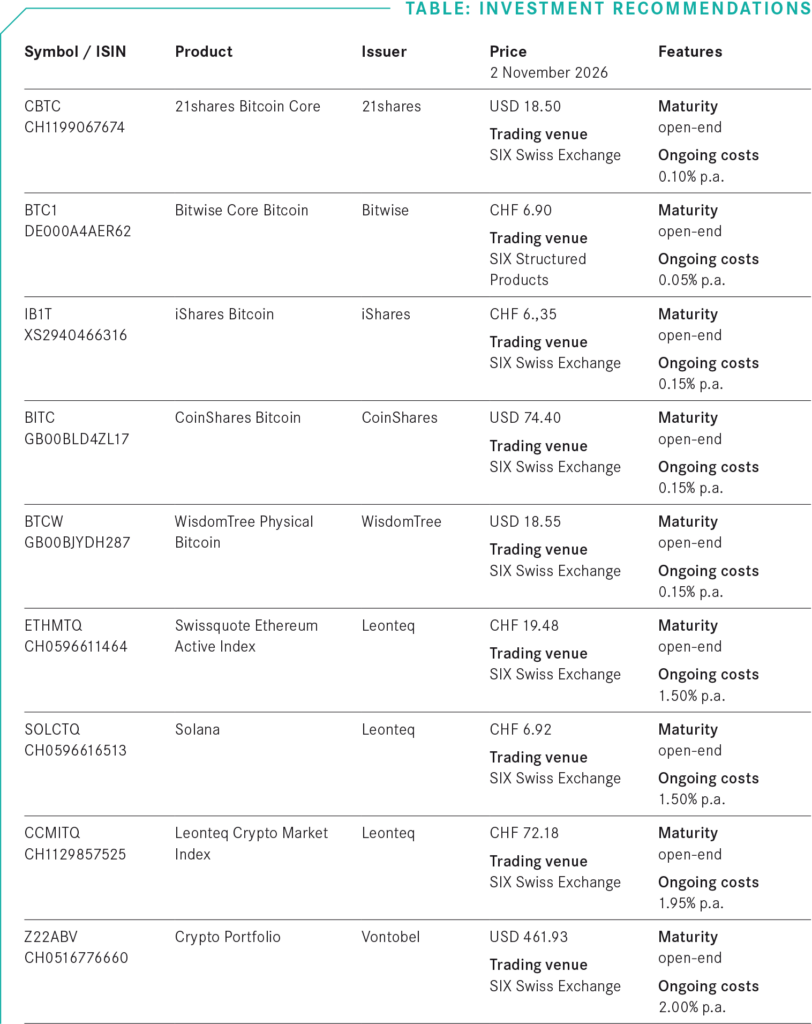
Switzerland is taking a pragmatic approach. Rather than aiming for a complete overhaul of the financial system, it is increasingly integrating digital assets into existing banking and exchange structures. The Zürcher Kantonalbank and PostFinance, for example, already offer their clients access to cryptocurrencies. UBS is also looking into corresponding offerings for wealthy private clients. The growing involvement of established institutions is likely to increase acceptance further. However, a distinction should be made between technical access and actual demand. A trading offering does not automatically lead to substantial portfolio allocations. For institutional investors, internal risk limits, regulatory capital requirements and high volatility remain key constraints. With around 283 listed Crypto ETPs, a broad product universe has developed on SIX Swiss Exchange, but the pace of new listings has slowed. This need not be a sign of waning demand, though; it may also point to increasing market maturity, with supply concentrating on economically viable products. For investors, the structure and tradability of the products are more relevant than their number. The effective total costs, the quality of custody, the collateralisation and liquidity in the secondary market are key factors in the attractiveness of a product. Especially with smaller issues, wide bid-ask spreads can quickly wipe out a supposed cost advantage.
First Swiss Bitcoin ETF – a Milestone with Open Questions
Another milestone came on 20 October 2026, when the Swiss Financial Market Supervisory Authority (FINMA) approved the first Swiss Spot Bitcoin ETF for retail investors. The Bitcoin Fund ETF, with the ticker BBIT, is issued by Zurich-based BIT Asset Management, a subsidiary of the internationally active BIT Group. Trading on SIX Swiss Exchange is scheduled to start in November. Unlike the established Bitcoin ETPs, which are mostly structured as debt securities, the ETF BBIT is an investment fund under Swiss law. The product is thus subject to the regulatory framework for collective investment schemes. The FINMA approved the fund as an “other fund for alternative investments” with special risk and, given the particular characteristics of Bitcoin, granted an exemption from the usual risk diversification rules. The Bitcoins are to be held physically and kept in cold storage at a Swiss bank. The passive investment strategy dispenses with derivatives and securities lending.
Despite this regulatory first, important questions remain unanswered. Although the provider has named AMINA Bank as custodian bank, potential distribution partners in the Swiss banking market have not yet been publicly named. The fee structure and the exact listing date are also still pending. For professional investors, the key questions will be how custody is organised, which banks actively distribute the ETF and whether sufficient trading liquidity develops. While the legal difference from existing ETPs is relevant, it guarantees neither lower costs nor better tradability. In addition, the FINMA expressly points out that the approval does not reduce the considerable market risk of Bitcoin. Therefore, the new ETF should be seen less as a direct driving force for the price than as a further step towards integrating Bitcoin into the regulated Swiss investment universe.
The Next Cycle Will Look Different
Bitcoin made a remarkable recovery in the 3rd quarter. Whether this marks the end of the crypto winter cannot yet be conclusively assessed, even though there are influential voices in the market who already see spring coming. Morgan Stanley, for instance, sees the crypto market at a possible turning point. Investment strategist Denny Galindo says that attention is increasingly shifting from “crypto winter” to a possible “crypto spring”. Bitwise CEO Hunter Horsley goes one step further. In early October, he told CNBC: “I think the crypto winter is over.” Amongst his arguments, he cited the fact that many sellers have already been forced out of the market, while institutions are expanding their activities and access via ETFs and ETPs is broader than ever before.
Whether the ice is actually melting remains to be seen. What can already be said with certainty today, however, is that the market has changed structurally. Spot ETFs and established financial institutions have made access easier and broadened the potential demand base. At the same time, Bitcoin is more closely linked to liquidity conditions in traditional financial markets. The historical four-year cycle remains a possible frame of reference but is losing explanatory power as new issuance declines and institutional participation grows. Therefore, for investors, it matters less whether the cyclical low was already reached in June or will only be reached in the 4th quarter. What matters more is whether institutional demand holds up under less favourable market conditions. The crypto winter is thawing. Whether a new bull market emerges from it will be decided not by Washington but by the ability of Bitcoin to attract capital on a lasting basis.