
 Focus
The Deceptive Calm on Wall Street
-

Wolfgang Hagl
Redaktor
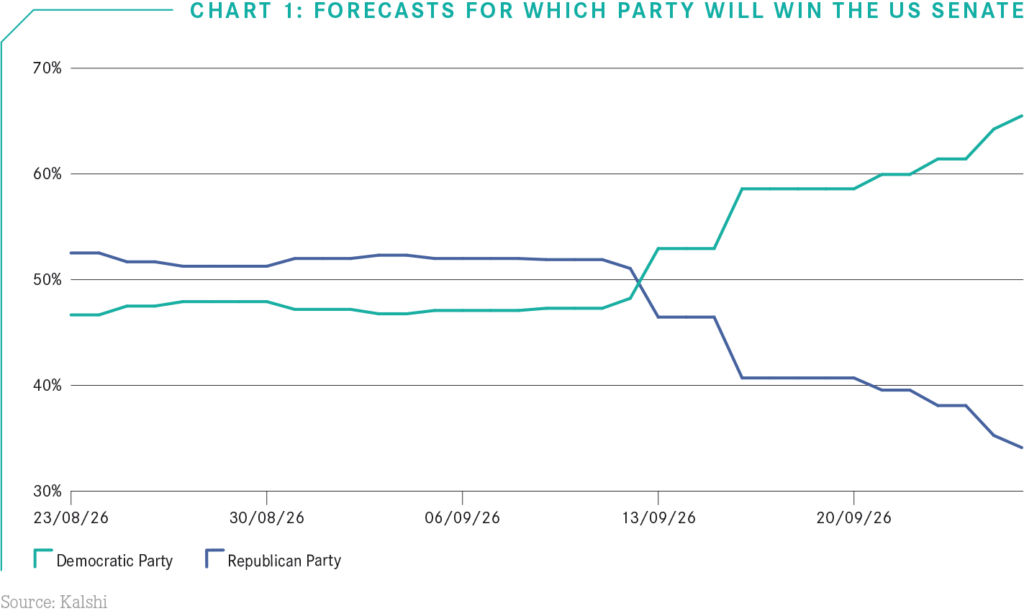
The US midterm elections on 3 November have long been casting their shadow over the country. And this time, the issue is not simply whether the party of the president can retain its majority in Congress. Election officials are preparing for legal disputes, disinformation, cyber attacks and possible political interference in the electoral process. At the same time, the Republican majority in the House of Representatives is razor-thin, while the race for the Senate has also become tighter. In mid-September, Morgan Stanley still viewed a Democratic victory in the House combined with continued Republican control of the Senate as its basic scenario. Just a few days later, participants on the prediction platform Kalshi put the probability of a Democratic Senate majority at 62%.
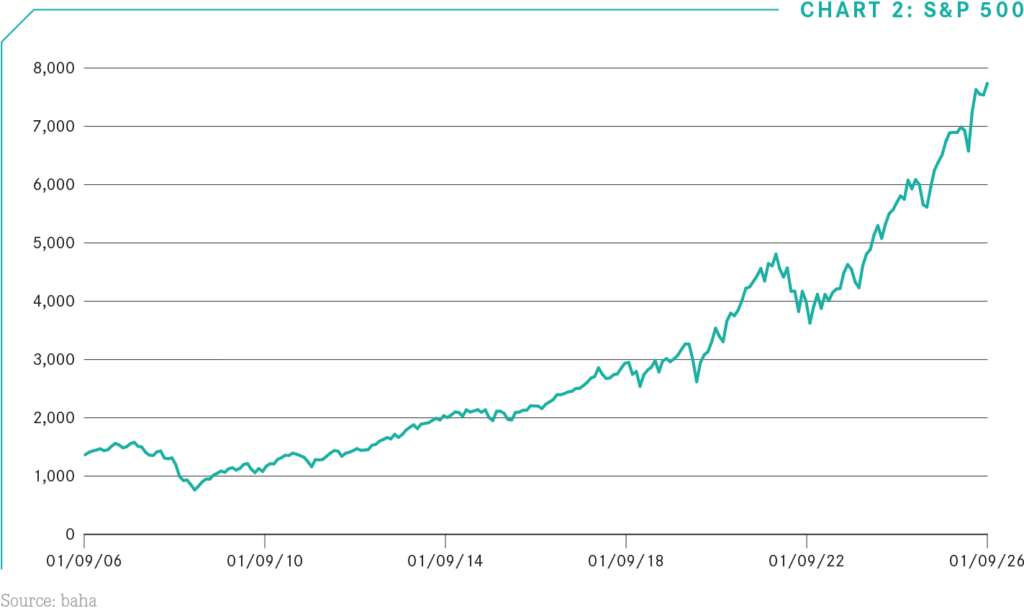
Wall Street has so far remained largely unfazed by this political back-and-forth. Compared with the end of 2025, the Dow Jones is up just over 8%, while the S&P 500 has gained around 13%. Both indices reached record highs in August, and on 22 September the Nasdaq also closed back at an all-time high. The main driving forces remain surprisingly resilient corporate earnings and the continuing boom in artificial intelligence. Against this backdrop, the S&P 500 has recently accelerated its long-term upward trend significantly. Since the beginning of 2023, the index has gained 100% and has increased almost sixfold over the past 20 years.
First the Jitters, then the Rally
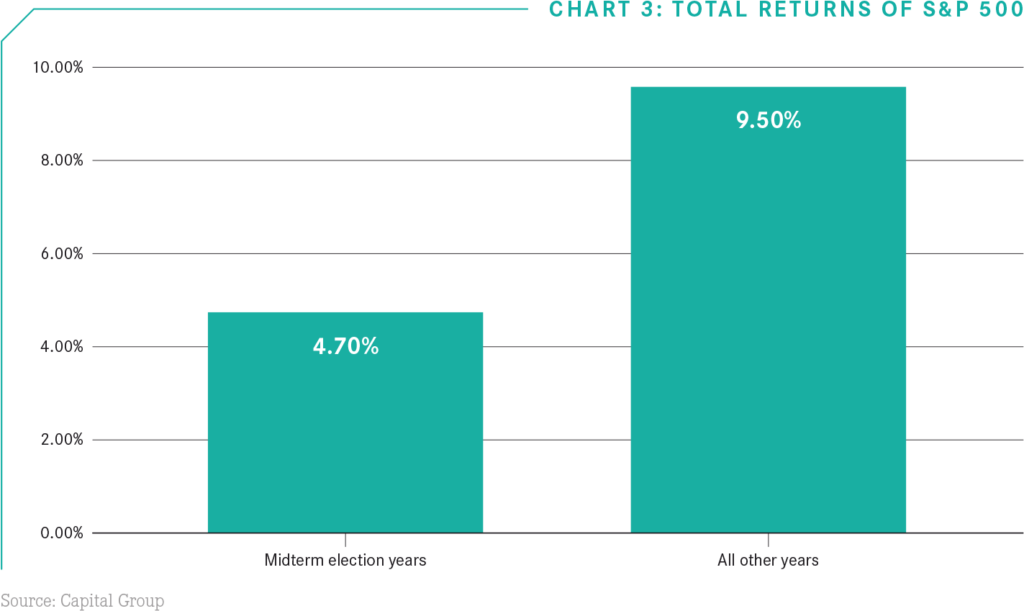
This apparent calm makes the coming weeks particularly interesting. Historically, the typical midterm pattern has been almost the opposite of what current market prices are suggesting. Nervousness often increases ahead of the election, with equities moving sideways or declining. The stronger phase frequently begins only once the political uncertainty has subsided. The long-term figures are striking. An analysis by Capital Group shows that the S&P 500 has generated an average total return of just 4.7% in midterm election years since 1930, compared with 9.5% in years without midterm elections. The typical market performance is particularly noteworthy: stock exchanges tend to move sideways for much of the election year before gaining momentum towards the end of the year.
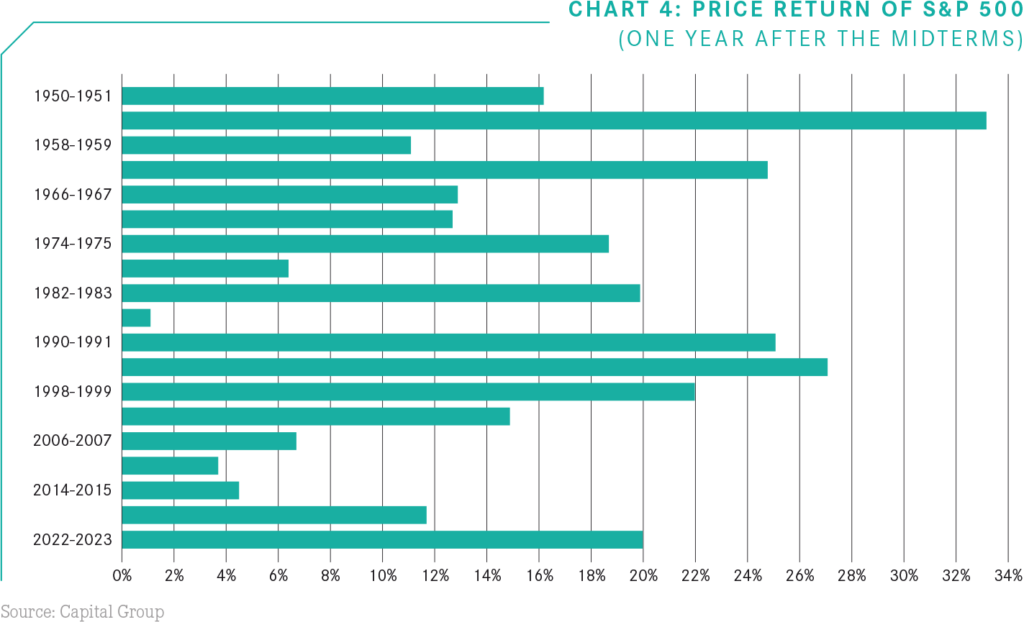
Using a different sample, Goldman Sachs comes up with the same broad pattern: In the 13 midterm election years since 1974, the median return of the S&P 500 from 1 August to Election Day was exactly 0%. At the same time, economic policy uncertainty typically increased ahead of the election and remained elevated for several months afterwards. However, the picture subsequently changed. The Capital Group examined every midterm election since 1950 and found that the S&P 500 gained an average of 15.4% in the 12 months following Election Day. Although Morgan Stanley uses a different methodology and a longer historical period, its result is similarly positive, at around 13% for the 12 months following the midterms. The historical result is particularly striking for a political configuration that appears possible in 2026: a Republican president and a divided Congress. According to Morgan Stanley, the S&P 500 gained an average of around 23% in the year following a midterm election under such a scenario, compared with 12% across all midterm configurations.
The Real Risk Lies in the Volatility
The midterm pattern is even more pronounced in the volatility than in average returns. According to the Capital Group, the median annualised volatility of the S&P 500 in midterm election years was just under 16%, compared with around 13% in other years. A difference of three percentage points may not sound substantial, but it represents a 23% increase in volatility. High volatility typically occurs when markets decline. An analysis by Cantor Fitzgerald supports this pattern: in 15 of the 24 midterm election years since 1930, the S&P 500 fell by at least 5% at some point between September and October. That is almost two-thirds of all cases. Therefore, the key risk is less a market crash on Election Night than heightened vulnerability in the weeks leading up to the vote.
This is where a notable discrepancy can be seen in 2026. At the beginning of September, the VIX – the fear barometer of Wall Street based on option prices – stood at around 15 points, well below its long-term average of 17.6 points. The VIX futures curve also showed virtually no midterm premium. “The VIX simply is not pricing in any particular election premium,” says Michael Purves, CEO of Tallbacken Capital Advisers. This may be the most important finding for investors: historically elevated volatility is currently meeting comparatively low expected volatility. That does not necessarily mean markets are convinced that the midterms will produce a favourable outcome. Rather, investors seem to assume that the elections will have little impact on corporate earnings. As Purves puts it: “The stock market is currently being driven primarily by earnings.”
Which Sectors Could Benefit?
If the Democrats win at least the majority in the House of Representatives, as is widely expected, while the Republicans retain the White House and potentially the Senate, Washington would largely be gridlocked. Morgan Stanley nevertheless sees such a divided government as providing favourable conditions for the defence, technology and financial services sectors. Given the geopolitical environment, defence spending enjoys broad support. In the sectors of technology, AI, semiconductors, cybersecurity and software remain strategically important, not least because of the competition with China. Banks could benefit from greater regulatory predictability and a more favourable environment for mergers. The downside of a divided Congress, however, would be renewed disputes over budget and debt ceiling, as well as more intensive congressional investigations. According to Morgan Stanley, this would increase risks for the energy sector, pharmaceuticals, private equity firms and digital assets. The direct impact politics can have on market prices was evident in mid-September, when the Clarity Act, backed by the crypto industry, failed in the Senate. Bitcoin and crypto-related shares fell immediately, although they quickly recovered their losses.
If, by contrast, both chambers remained Republican, continuity in the tax, deregulation and energy policies of the Trump administration would initially be expected. Yet this does not necessarily translate into a straightforward “Republican trade”. Michael Hartnett and his strategy team at the Bank of America pointed out earlier this year that efforts by Trump to lower the cost of energy, medication, loans, housing and electricity ahead of the midterms could weigh on major energy companies, pharmaceutical groups, banks and Big Tech. Therefore, Hartnett identified small- and mid-cap US companies as potential beneficiaries of the election year.
A Democratic takeover of both chambers would increase political friction even further. President Donald Trump would remain in office and could use his veto to block much of the legislative agenda of the Democrats. A Democratic-controlled Senate, however, would make appointments, including those of new judges, considerably more difficult. Both chambers would also gain significantly greater investigative and budgetary powers. For the share market, this would probably be less of a conventional shift to the left than a scenario of maximum gridlock. In the run-up to the election, appointments of new judges had already accelerated as the White House factored in the possibility of losing the majority in the Senate. Competition between the political parties is already under way: in September, the democratic-oriented equity ETF DEMZ significantly outperformed its Republican counterpart ETF MAGA. Over a six-month period, DEMZ is also clearly ahead, with a gain of around 18%.
The Federal Reserve in Focus
Away from the midterms, investors are currently paying particular attention to interest rates, which matter more to markets than events in Washington. This is all the more relevant now as the monetary policy environment has become more difficult. On 16 September, the Fed raised its target range for the federal funds rate by 25 basis points to 3.75%–4.00%, citing inflation remaining too high, despite the fact that the economy continues to expand at a solid pace, consumer spending is holding up well, and productivity and investment are strong. The projections of the Fed paint an unusual picture for 2026: real GDP growth of 2.3% and unemployment of just 4.1%, alongside PCE (Personal Consumption Expenditures)inflation of 3.7% and core inflation of 3.4%. For 2027, policymakers expect PCE inflation to decline to 2.3%.
For equity investors, the question is no longer when the Fed will cut rates, but how much further it will have to raise them. The yield on 10-year Treasuries briefly reached 5% following the September decision, its highest level in 19 years. J. P. Morgan does not yet regard this environment as necessarily dangerous. The bank points out that while rising interest rates reduced the valuation multiples of the S&P 500 by around three P/E points over the past year, US equities nevertheless rose strongly due to significantly higher earnings. On an adjusted basis, the US bank expects earnings growth of around 28% in 2026 and 21% in 2027. According to J. P. Morgan, history shows that with earnings growth of this magnitude, equities can withstand 10-year yields in the 5% – 6% range. In the view of the strategists, the situation would become more critical if the moderate tightening currently expected was to develop into a broader cycle involving another four or five rate increases. According to CME FedWatch, the market currently expects two further increases this year – on 28 October and 9 December. For 2027, a majority for another increase is currently not expected.
Interest rate developments will also help determine which sectors ultimately come out ahead. History shows that energy and financial shares have performed particularly well when long-term yields have risen faster than short-term rates. Real estate and utilities, by contrast, have noticeably fallen behind. When the interest rate curve has flattened, technology has been the clear winner. A sector that appears to be an election winner can quickly become a share-market loser if the bond market moves in the wrong direction.
Investing Around Election Day
In the short term, there are several reasons not to confuse the calm on Wall Street with safety. The historical frequency of pullbacks in September and October, a low VIX, elevated equity prices, 10-year Treasury yields around 5% and a Fed that has returned to a rate-hiking path form a combination in which even relatively minor surprises could trigger significant market moves. The midterms themselves do not necessarily have to be the catalyst; rather, they increase the number of potential political triggers. Over the medium term, however, the direction of markets will be determined less by Washington than by the balance between earnings growth and the cost of capital. If the AI-driven investment and productivity boom continues and corporate earnings do indeed grow at double-digit rates, above-average valuations could remain sustainable despite high interest rates. However, if earnings growth weakens while yields continue to rise, the current apparent calm could quickly turn into a problem.

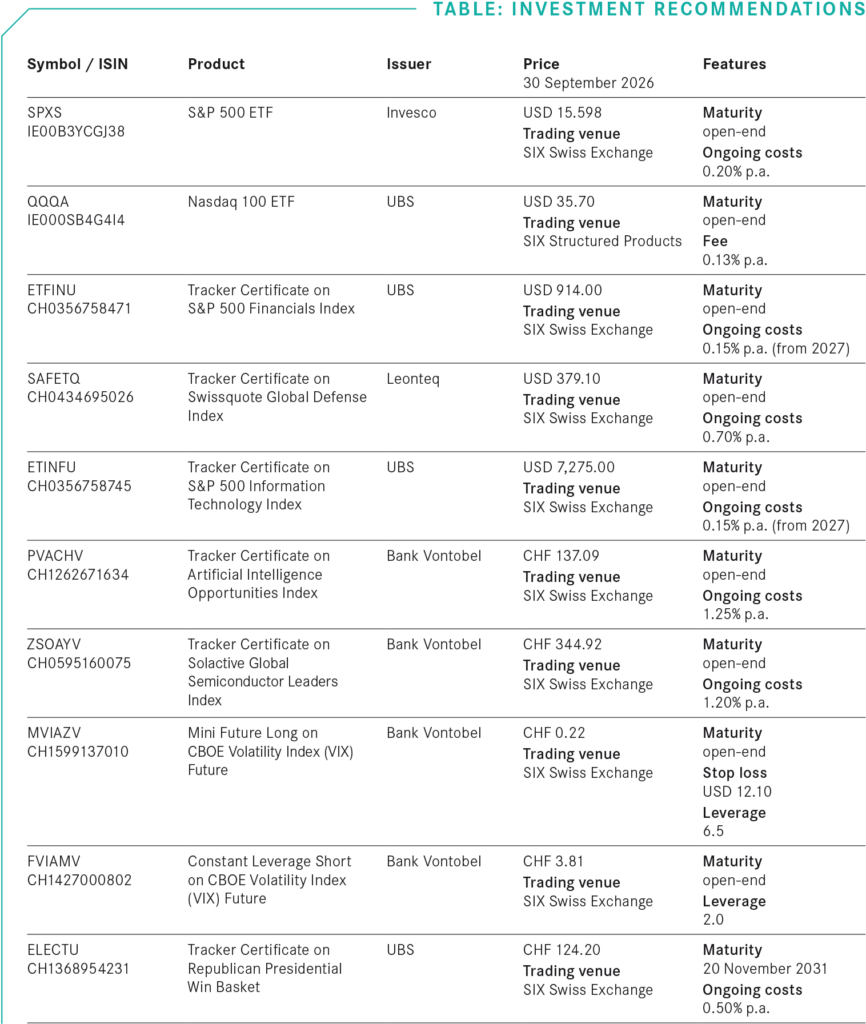
Investors who want to do more than simply watch the midterms and instead position themselves tactically around Election Day have several options: ETFs on the S&P 500 or the Nasdaq 100 offer broad market exposure, for example the Invesco S&P 500 ETF or the Nasdaq 100 product by UBS. Investors seeking more targeted exposure to potential election effects can use Tracker Certificates to position themselves in individual themes and sectors: US financials via the S&P 500 Financials Index, technology shares via the S&P 500 Information Technology Index, defence and security shares via the Swissquote Global Defense Index, or AI and semiconductor themes via corresponding Vontobel products. For investors expecting larger market swings in the weeks surrounding the election, Leveraged Products on the VIX volatility index are another possibility – be it a Mini Future Long to position for rising nervousness or a short product for a subsequent decline in volatility. There is even a very specific political theme in the form of the “Republican Presidential Win Basket”. The equity basket has gained around one-fifth in value since its launch in November 2024.