

 Focus
Focus
Bonds: A Solid Foundation, Attractive Opportunities
-

Wolfgang Hagl
Redaktor
In the public eye, bonds often take a back seat to shares. This is all the more true given that fixed-income securities cannot keep up pace with dividend-paying shares, which have been on a bull run for years. Nevertheless, it is worth taking a closer look at this important and very large asset class. It helps to diversify a portfolio, generate regular income and is, moreover, indispensable for structuring investment products.
It is not possible to pinpoint exactly when the idion “to be in the red” first came into use. It goes back to a time when accountants traditionally used red ink to write down negative numbers, debt, and losses.
The whole world is massively “in the red”. A glance at the global bond markets provides evidence for this theory. In 2024, fixed-income securities with a total volume of around USD 145 trillion were in circulation. Over a decade, this market had thus grown by an average of 5.7% per year. (refer Chart 1) Admittedly, the share market rally led to an even stronger expansion in the equity markets. However, at USD 126.7 billion, the market capitalisation of the asset class that usually attracts the most attention still lagged behind the global bond segment in 2024.

A simple principle,…
This discrepancy alone highlights the enormous importance of fixed-income securities. They enable governments, institutions and companies to raise capital. The issuer undertakes to the purchaser or subscriber of a bond – also known as an obligation – to repay the sum provided, the nominal value (see glossary), in full on a specified date (maturity). In return, creditors receive regular interest payments. The amount of these payments is determined by the coupon of the bond. For a long time, it was primarily governments and large corporations that utilised this source of financing. Their counterparties as capital providers were insurance companies, pension funds and private investors.
…a complex evolution
The modern bond market emerged from around the 1970s onwards. Supply grew steadily. “Investors realised that money could be made by buying and selling bonds on the secondary market”, explain the experts at Pimco, an asset manager specialising in fixed-income securities. Computer technology also played a part in this, as it made it possible to calculate bonds and their parameters more quickly. In this way, more and more issuers gained access to this market. At the same time, investors were able to optimise their risk-return profiles. “Today’s bond market comprises a diverse range of issuers and bond types”, Pimco notes.
USA: Rising debt, declining creditworthiness
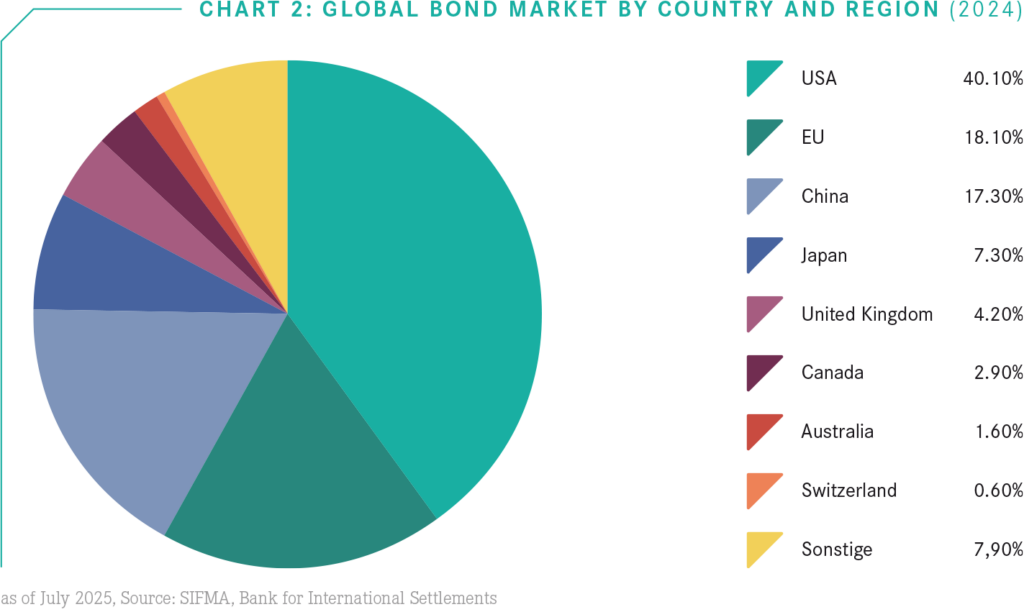
As far as the players on the debt side are concerned, there is a clear pecking order. According to figures published by the Securities Industry and Financial Markets Association (SIFMA), the US accounted for a good 40% of global bond markets in 2024. It is followed by the EU, China and Japan. According to the US trade association, government and corporate bonds worth around USD 825 billion were outstanding in Switzerland, resulting in a global market share of 0.6% (refer Chart 2). A key player in the bond market is the U.S. Department of the Treasury. Based in Lafayette Park, Washington D.C., the department is responsible for raising funds for the government. As is well known, the US debt mountain is growing at a rapid pace. At the start of the year, liabilities totalled more than USD 39 trillion – meaning that national debt had more than doubled within 10 years (refer Chart 3).

For a long time, the Treasury was able to rely on the status of the USA as an economic superpower and a reliable debtor. However, this image has taken a knock. Almost exactly 15 years ago, the rating agency Standard & Poor’s stripped the US of its top rating and downgraded its credit rating from “AAA” to “AA+”. President Barack Obama was in office at that time. Fitch followed suit in August 2023 during Joe Biden’s presidency. Moody’s was the third and final one of the three major rating agencies to adjust its rating: in May 2025, a few months after Donald Trump’s return to the White House, the credit rating of the USA was cut from “Aaa” to “Aa1”. In its statement, Moody’s pointed out that the financial situation of the USA was expected to deteriorate further compared with the past and relative to other highly rated countries.
Several influencing factors
Creditworthiness is one of the most important drivers of bond prices, which generally move inversely to yield. The reason being as follows: In the traditional structure, a bond is issued at 100% of its nominal value. The coupon relates to this amount, also known as the denomination. As soon as the price of the bond falls below par (100%) in market trading, the yield rises – and vice versa.. In addition to changes in creditworthiness, key interest rates, inflation expectations, remaining maturity (or duration) and, of course, the interplay of supply and demand all have an influence on prices.
Although this complex mix entails various risks, bonds are considered defensive investments compared to shares. In addition to fixed, predictable interest payments, creditors have their capital repaid at maturity. Should a debtor run into difficulties and be unable to redeem the bond, insolvency proceedings may be initiated. Bondholders then usually have access to the assets and can hope for at least partial repayment. Meanwhile, shareholders must take a back seat following a bankruptcy – they often come away empty-handed. There is neither a repayment guarantee nor a right to dividends for shareholders’ capital. This does not change the fact that a company’s dividends are often lucrative sources of income. Particularly in the recent past, taking a chance has paid off. Since the global financial crisis of 2008/2009, share prices have been trending sharply upwards.
Under the spell of monetary policy
A key catalyst for the long-standing share market rally was the lack of alternatives. Investors turned increasingly to shares as returns in the fixed-income segment were dwindling. Major central banks have combated various crises with veritable floods of money, thereby more or less wiping out interest rates.
Take the Fed, for example: when the coronavirus began to spreading in spring 2020, the US Federal Reserve set its key interest rate to zero – just as it had done twelve years earlier. The yield on 10-year Treasuries subsequently fell to 0.54%. As is well known, global supply chains came to a standstill in some cases in the wake of the pandemic, which in turn caused a massive surge in inflation. The Fed counteracted by raising interest rates, thereby pushing the yield on government bonds back towards 5% (refer Chart 4). It actually seemed like the latest battle against inflation had been won; in the US and elsewhere, monetary policy was eased again in 2025. However, the war in Iran has rendered all projections meaningless. As energy prices rose, inflation shot up once more. At the start of the year, the markets had firmly expected the Fed to cut interest rates in 2026. Yet now, there could even be a rise this autumn.

Weakness with exceptions
Due to the inverse relationship between yield and price outlined above, prices on the bond market have shown a tendency to fall. The coupons received were generally insufficient to offset these discounts. A glance at the performance statistics for exchange-traded funds (ETFs) in this asset class speaks volumes. Swiss Fund Data lists 319 bond ETFs. Of these, only 17 have achieved a positive return over a five-year period. Over a shorter three-year period, however, the database shows that just under one in five passive funds has generated a profit.
Investment solutions
UBS Bloomberg MSCI Global Liquid Corporates Sustainable Bond Index CORPS meets both of these criteria. This passive fund comprises just under 1,700 corporate bonds from North America, the eurozone and the UK. The key requirement for being accepted as a component of the fund is an investment-grade rating. The issuer must therefore have good to very good creditworthiness. Furthermore, the methodology specifies liquidity criteria relating to the outstanding amount. The index is rebalanced monthly, with interest income added to the fund’s assets. Currently, this relatively small fund has accumulated a yield of 4.71% to date.
The iShares Global Govt Bond ETF IGLO focuses on government bonds. The benchmark comprises just under 900 debt securities issued by developed countries. The US sets the tone, accounting for more than half of the weighting. As such, the ETF is closely linked to Fed policy and also benefits from the comparatively high interest rates in the US dollar area when it comes to distributions. At the end of July, the yield – which is passed on to fund holders via distributions – stood at 3.91%. On the price front, the cycle of interest rate rises following the COVID-19 pandemic has held the ETF back. All attempts at recovery have so far failed due to recurring speculation about further interest rate rises. This product is therefore of interest to investors who expect inflation to ease and the Fed to adopt an easier monitary policy stance sooner or later.
Active, global approach
Whilst passive strategies operate within a relatively strict framework, active approaches can react to market conditions at any time. The managers of AURELYS AKTING Unconstrained Bond Index have demonstrated a knack for success. This strategy aims to “achieve steady capital growth and recurring income over the medium to long term, whilst keeping volatility as low as possible.” To this end, it utilises corporate and government bonds from developed and emerging markets. Aurelys SAM has been responsible for the index for a good two years. The experts at the Monaco-based broker describe their approach as opportunistic. “The selection approach focuses on fundamental analysis with selective credit assessment,” they write in a guide.
The results are impressive: AURELYS AKTING Unconstrained Bond Index has been on a stable, upward trend for a number of years. There are currently 21 bonds in the portfolio. Among the largest positions are bonds from Deutsche Bank and Julius Bär.
Vontobel replicates the strategy with the tracker certificate PSTRRV. Compared with ETFs, the costs are high. In addition to an index fee of 1% p.a., a performance fee of 15% is retained should the fund outperform. Another minor drawback: the product is not listed on a stock exchange. However, investors can trade via Vontobel directly and the brokerage services of Swissquote, PostFinance and Raiffeisen.

At the heart of it
The fixed-income asset class plays a central role in the market for Structured Products. Bonds are theirfundamental building block, as a certificate is legally a bearer bond. Issuers typically use zero-coupon bonds to structure the desired payout profile. In an environment of relatively high interest rates, comparatively attractive pay-offs can be achieved. Conversely, it becomes more difficult to issue lucrative products once yields hit rock bottom. Unsurprisingly, Structured Product providers also make full use of the fixed-income spectrum when it comes to underlyings There is a wide range of Tracker Certificates that implement such strategies.
The Barrier Reverse Convertible (BRC) bridges the gap between asset classes. This structure combines the terms of a bond with the risk associated with shares or other assets. In this way, investors can achieve relatively high coupons. They will only receive the full nominal back provided the underlying does not fall to or below the barrier. In this respect, investors should be confident in the stability of the underlying as soon as they set out to chase coupons on this basis. As soon as the respective buffer proves insufficient, the investment is exposed to the full risk of the underlying.
Glossary
Bond
An instrument for raising capital on the capital market. These securities, also known as bonds or obligations, can be issued in various currencies, with different maturities and interest rates.
Credit rating
The creditworthiness of the issuer; this indicates the quality of a bond in terms of the likelihood of repayment.
Coupon
Regular interest payment to the bondholder.
Duration
The capital-weighted remaining maturity of a bond in years. In addition to the repayment at maturity, the ongoing coupon payments are taken into account. This key figure is used to measure the impact of interest rate changes on the value of a bond.
Effective yield
The annualised return on a bond, taking into account the coupon, purchase price and redemption amount.
Nominal
The face value stated on a bond, which forms the basis for interest calculations.
Zero-coupon Bond
Also known as a “zero bond”, this is a bond with no regular interest payments. Investors receive only the repayment of the capital at maturity. The return is calculated as the difference between the purchase price and the redemption amount.