
 Focus
Focus
Currencies Facing Headwinds from Politics and the Market
-

Wolfgang Hagl
Redaktor
The joint intervention by Japan and the US to support the yen has rattled the foreign exchange market. The Bank of Japan could now follow up with an interest rate hike as early as september. The episode illustrates just how powerful interventions can be in the short term – and how quickly their impact can fade. For market participants, opportunities arise not only from interventions: more broadly, the foreign exchange market is an eldorado for bold investors.
There are moments in the foreign exchange market when it is not economic data, inflation figures or the next central bank meeting that set the tone, but the government itself. The end of July saw another such moment. After the yen had fallen to close to JPY 164 against the dollar – a 40-year low – Japan intervened on a massive scale. According to estimates based on data from the Bank of Japan (BoJ), up to JPY 8.2 trillion – equivalent to around USD 50 to 55 billion – was deployed in one of the interventions to prop up the yen. The US also took part in the intervention. The reaction was clear: the USD/JPY exchange rate plummeted from just under 164 to around 155 at times. However, the limits of such interventions soon became apparent. By mid-August, the pair was already trading around JPY 159 again, meaning the yen had given back about half of its gains. The market now regards JPY 160 as a level at which the risk of renewed official intervention rises significantly.
Tokyo could soon attempt to give the intervention more substance through monetary policy. According to media reports, the BoJ is considering raising the key interest rate as early as its meeting in mid-September. The short-term rate has stood at 1% since June, after the central bank raised it from 0.75%. The likelihood of a move in September has recently risen significantly in the market. At the same time, yields on ten-year Japanese government bonds climbed in August to their highest level in around three decades. Such a move could prove more significant for the yen than the next few billion on the foreign exchange market. This is because the unusually large interest rate differential between Japan and other industrialised nations has, for years, been a key reason for borrowing yen and channelling the funds into higher-yielding investments. The more the BoJ narrows this spread, the more expensive this carry trade becomes – and the more fundamentally an appreciation of the yen is underpinned. Mitsuhiro Furusawa, President of the Institute for Global Financial Affairs, therefore considers further interventions possible, but at the same time emphasises that interventions alone cannot permanently resolve the currency’s weakness. “Most market participants expect the BoJ to raise interest rates in September, and I think that is how it should be,” says Furusawa, adding: “But what is even more important is that the central bank signals that interest rate rises could come sooner.”
When billions collide with reality
Foreign exchange interventions have an impact on several levels. When a central bank buys its own currency, it removes supply from the market and creates additional demand. If the volume is sufficiently large, this can have an immediate effect on the exchange rate. Equally important is the psychological effect: the authority signals that it will not accept a certain exchange rate trend. Anyone holding large short positions in the yen must factor in the possibility that the government could reappear on the opposite side of the trade at any time. If interventions are unexpected and, as on this occasion, coordinated internationally, this deterrent effect is heightened. Yet history also shows the limits. Switzerland provides a clear example: In September 2011, the Swiss National Bank (SNB) introduced a minimum exchange rate of CHF 1.20 per euro for the EUR/CHF pair, after the flight to the franc had driven its appreciation so far that the SNB feared serious consequences for the economy and price stability. It declared its readiness to buy foreign currency in unlimited quantities to defend this threshold. The strategy worked for more than three years.
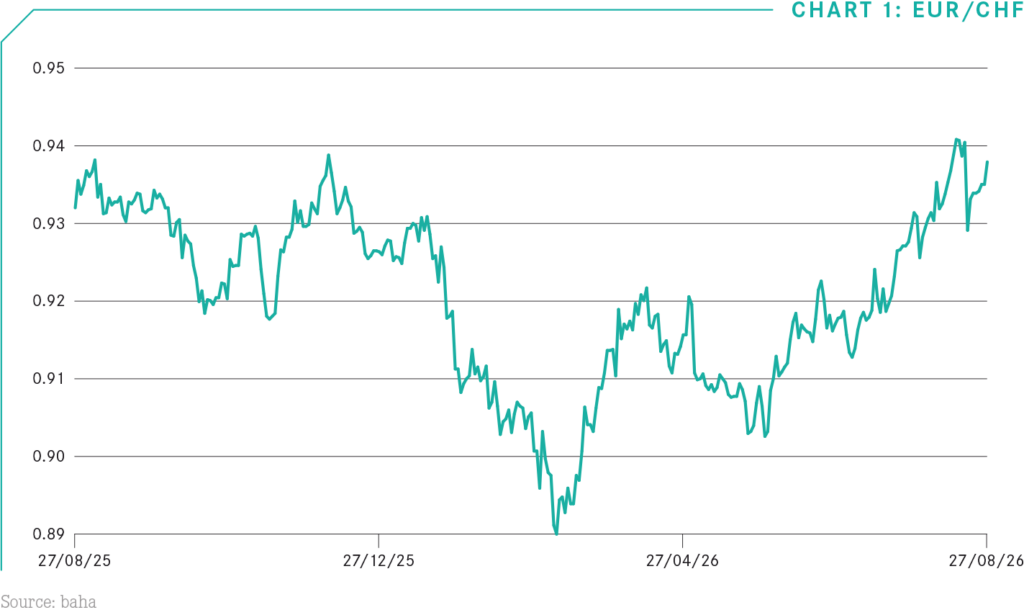
However, even a central bank with the ability to create its own francs in theoretically unlimited quantities cannot ignore economic forces indefinitely. As the euro came under increasing pressure in early 2015, the SNB stated that defending the CHF 1.20 level would have required permanent interventions on a rapidly expanding scale. The central bank ultimately described the lower limit itself as no longer sustainable and lifted it on 15 January 2015. The British attempt to defend an exchange rate against the fundamental forces of the market was even more drastic. On 16 September 1992 – later known as “Black Wednesday” – the Bank of England bought massive amounts of British pounds in order to keep sterling within the European Exchange Rate Mechanism (ERM). The problem was that the UK was suffering from a weak economy, whilst German reunification was keeping interest rates high in Germany. Defending the British pound thus forced London to pursue a monetary policy that was increasingly at odds with the domestic economy. Despite interventions and signals regarding interest rates, the UK capitulated on the very same day and suspended the British pound’s membership of the ERM.
The lesson to be learnt from both episodes is crucial for the yen today: interventions can reverse market trends, adjust positions and deter speculators. However, defending an exchange rate in the long term against interest rate differentials, inflation, growth and capital flows is considerably more difficult. The more the intervention is supported by other economic policies, the more sustainable its effect. This is precisely why a BoJ interest rate rise in September could retrospectively lend the recent yen intervention the credibility that pure yen purchases can only provide to a limited extent.
What really drives currencies…
Interventions are just one of many forces that have a direct influence on a currency pair. In day-to-day trading, currencies react primarily to actual and expected interest rate differentials, inflation and growth, fiscal and current account developments, commodity prices, political risks and capital flows, as well as to the positioning of major investors. During periods of stress, a currency’s status as a safe haven also comes into play; for commodity currencies, however, oil, metals and the global economy play a particularly significant role. To find out how these factors interplay and why even positive economic data can sometimes weaken a currency, read the Learning Curve “What Really Moves Currencies” from page 19.
…and why this matters
A glance at the scale of the figures shows that foreign exchange generally plays a significant role in the capital markets. In its latest three-year survey for April 2025, the Bank for International Settlements reported an average daily turnover of USD 9.6 trillion in the global foreign exchange market – 28% more than in 2022. The US dollar was involved in 89% of all transactions. In terms of trading volume, the foreign exchange market is thus the world’s largest financial market.
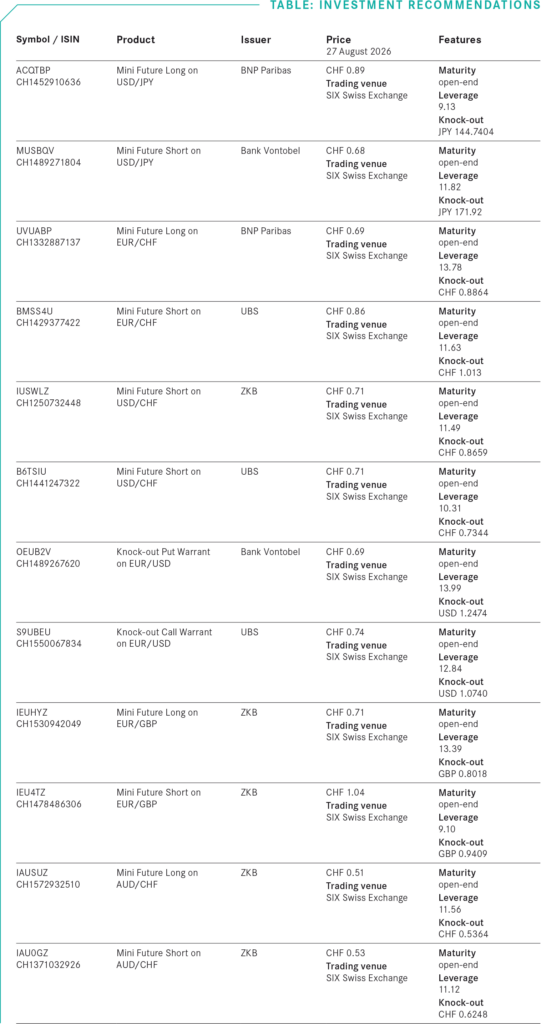
This asset class also plays a significant role amongst Swiss retail investors and in the market for Structured Products.
According to SSPA figures, 30% of turnover in the second quarter was attributable to foreign exchange. This made currencies the second-largest asset class after equities. The recent movements in the yen therefore demonstrate that hardly any other market reacts so immediately to changes in interest rate, political and risk expectations.
Five currency pairs, five different bets
For investors, however, this does not mean that there is only one correct currency strategy. Each pair reflects a different macroeconomic narrative, and it is almost always possible to formulate a plausible scenario for both sides. Let us take a look at the Swiss franc. It has lost considerable ground since early summer – EUR/CHF rose temporarily to around CHF 0.94 in mid-August. One short-term reason for this is the intervention in the yen: those avoiding the yen as a funding currency for carry trades due to the possibility of government intervention may switch to the franc, which also offers low interest rates. Morgan Stanley now rates the franc as neutral with a positive bias and expects that longer-term purchasing power parities could once again put pressure on the EUR/CHF exchange rate, albeit more slowly than initially anticipated. On the other hand, the franc’s interest rate disadvantage argues in favour of a higher EUR/CHF exchange rate. For investors, this is a classic dilemma between a long EUR/CHF position – as a carry trade and “risk-on” position – and a short EUR/CHF position – as a bet on a comeback for the franc as a safe haven.
The USD/CHF currency pair pits two safe-haven currencies against one another. Julius Bär does see several short-term supports for the dollar, such as geopolitical uncertainty, demand for US assets, the AI investment boom and the US’s position as a net energy exporter. Structurally, however, the firm expects a gradual weakening of the greenback, partly due to US fiscal and current account imbalances. Morgan Stanley also remains neutral on the dollar with a negative bias and views falling US interest rate expectations as a headwind. Weaker US data has recently supported this narrative. Added to this are discussions about US government bond buybacks, which are weighing on the dollar. A short USD/CHF position would therefore be a bet on a further weakening of the dollar.

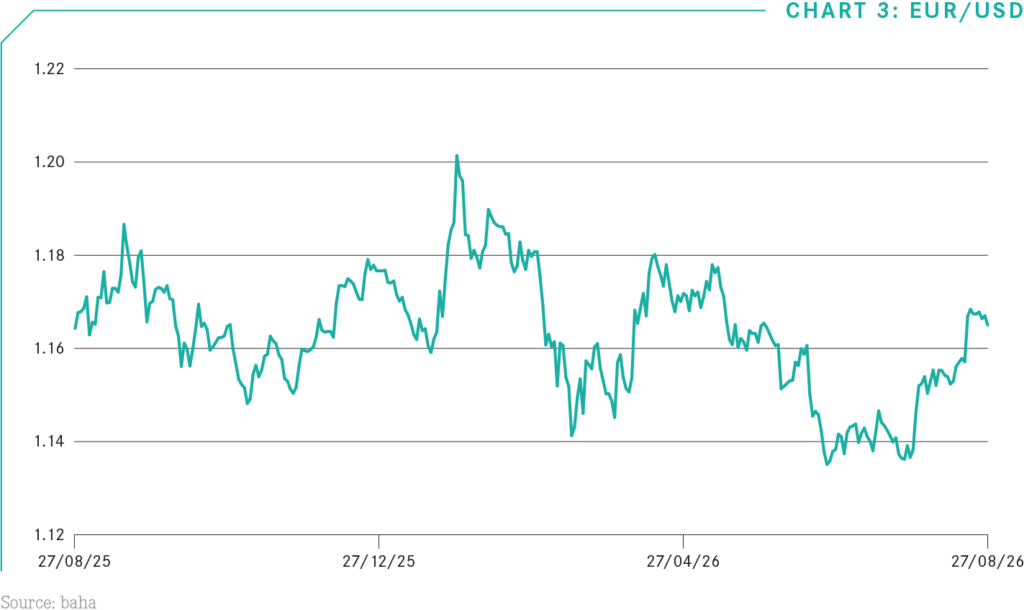
The world’s most important currency pair, EUR/USD, is currently driven primarily by the question of which part of the Atlantic region will have to revise its interest rate expectations more sharply. The euro climbed to close to USD 1.16 in August, after weaker US labour market and inflation data had dampened expectations of further Fed interest rate rises. Morgan Stanley therefore sees upside potential for EUR/USD due to a weaker dollar, but at the same time warns of headwinds for Europe stemming from growth, energy and political risks. Julius Bär makes a similar argument and expects a gradually weaker greenback rather than a dollar crash. Another factor favouring euro bulls is that monetary policy on both sides of the Atlantic is increasingly diverging. Whilst the futures markets are pricing in a roughly 90% probability of an interest rate rise at the ECB meeting on 10 September, the probability for the US Federal Reserve (Fed) on 16 September stands at only around 35%.
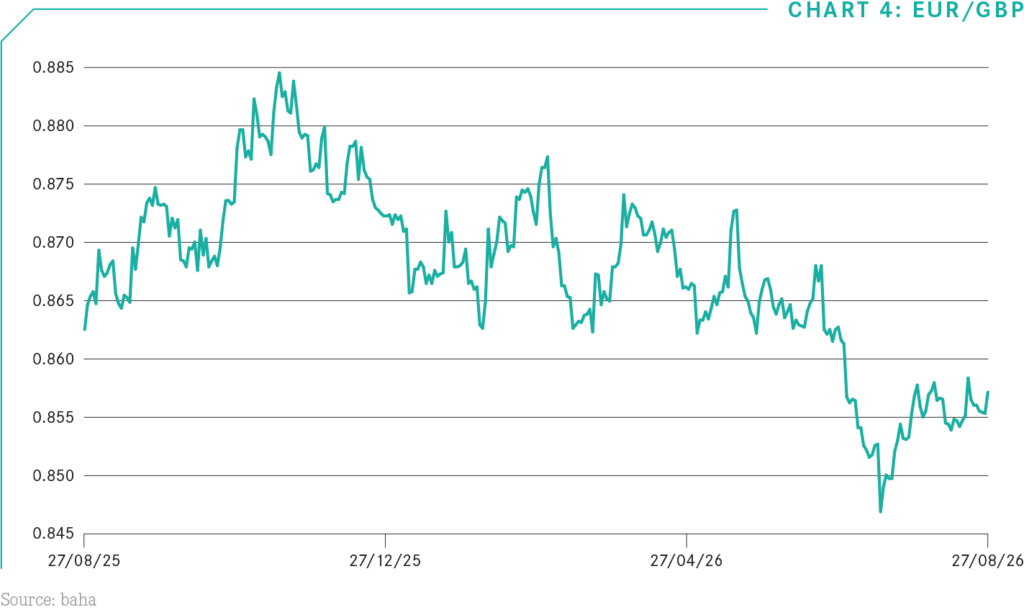
An interesting situation is also emerging for EUR/GBP. With regard to the British pound, the focus is increasingly shifting from the Bank of England (BoE) to UK fiscal policy. Morgan Stanley believes sterling could lag behind in the medium term should the BoE shift its monetary policy back towards a more dovish stance. On the other hand, the comparatively attractive interest rates are supporting the British pound. Experts at DWS also point to the UK autumn budget: “Remarkably little volatility is priced into the options market, but unexpectedly high spending, tax burdens or rising debt could hit sterling hard,” they say. At the same time, the latest UK labour market data show a slowdown. A long EUR/GBP position therefore bets on weaker UK fundamentals and fiscal risks, whilst a short EUR/GBP position bets on a more restrictive BoE.
Of the five currency pairs, the Australian dollar (AUD) may well have the most pronounced carry component. Morgan Stanley describes the currency from Down Under as its preferred bullish G10 currency position: a more restrictive Reserve Bank of Australia, comparatively high yields and low implied volatility all point in favour of the Aussie, according to the strategists. For the AUD/USD currency pair, the bank has set a target of USD 0.75 for the coming quarters. Julius Bär also favours the AUD on the basis of interest rates, commodity links and monetary policy. At the same time, UBS strategists expect the Swiss franc to remain under pressure, particularly against higher-yielding, cyclical currencies. A long AUD/CHF position therefore capitalises on carry trade opportunities, global economic conditions and risk appetite. A short AUD/CHF position, by contrast, would serve as a hedge against a “risk-off” shock, falling commodity prices or a global growth disappointment, in which case the Swiss franc is likely to reassert its safe-haven status.

Speaking of hedging: FX products can also be used to reduce currency risks in a portfolio – a process known in technical jargon as hedging. This allows potential exchange rate losses on an investment to be reduced or offset by gains from the foreign exchange position (see payoff magazine, April 2026, Learning Curve “Forex: The Fascinating World of Currencies”).
The right instrument for the right view
How investors put these views into practice depends crucially on their investment horizon. Those wishing to capitalise on short-term movements can use leveraged products such as Warrants or Knock-out Products to bet on both rising and falling currency pairs. Leverage makes movements of just a few percentage points particularly attractive. But be careful: the same mechanism multiplies losses. With knock-outs, a brief price spike – such as might occur at any time during an intervention – can even bring the position to an abrupt end.
For longer-term currency strategies, unleveraged exchange-traded currency products are a viable option. Depending on the market, these are offered as ETPs or ETNs. They can largely track the movement of a currency pair on a one-to-one basis. For example, anyone holding a long position in EUR/USD is, in economic terms, simultaneously betting on a stronger euro and a weaker dollar. In addition to the direction of the movement, the product structure, costs, collateralisation and, where applicable, issuer risk are crucial factors.
A special variant exists in the German certificate market in the form of inline Warrants. Here, a currency pair does not even need to rise or fall: the key factor is that it remains within a pre-defined range during the maturity. In that case, a defined maximum amount is paid out at the end. If, on the other hand, the price touches or breaches even one of the two barriers, the product is “knocked out” and investors suffer a total loss. This can be particularly interesting during sideways trading phases, such as those experienced by EUR/CHF for a long time. However, in a market where central bank intervention can move exchange rates by several % within minutes, the barrier risk is considerable.
So, back to Japan once more. The latest intervention has shown that governments can throw even the world’s deepest and most liquid market off balance for a few days. Whether they also create a new trend will be decided afterwards. Should the BoJ actually raise interest rates in September, whilst expectations of further Fed tightening subside, the fundamental support for a stronger yen would increase. If this confirmation fails to materialise, USD/JPY could once again test the 160 mark and the market would likely immediately start speculating on when Tokyo and Washington might intervene again. For investors, it is precisely this tension that represents both an opportunity and a risk.