
 Focus
Focus
Gold at a crossroads: Is it time to bet against the myth?
-

Serge Nussbaumer
Kapitalmarktexperte
Gold is shining – but perhaps only for show. While investors around the world are in record fever and celebrating the precious metal as the ultimate safe haven, more and more experts are warning that the rally is exhausted and the risks outweigh the benefits. Anyone still betting on rising prices could be walking into a trap. Courageous investors, on the other hand, are asking the provocative question: is it time to short gold and thus profit from the possible fall of the supposedly unshakeable store of value?
Hardly any other asset polarizes the financial world as much as gold. Some see it as a “safe haven” in uncertain times and the ultimate hedging instrument against inflation and geopolitical crises. Others, on the other hand, see gold as an unproductive commodity that yields neither interest nor dividends and whose value is based solely on collective expectation. Precisely because gold has been a symbol of stability and wealth protection for centuries, it is all the more surprising that numerous experts are now raising cautionary voices. After the recent bull market and record highs on the gold market, there are increasing arguments that the air has become thin and that investors no longer see the precious metal price merely as a hedge, but could speculate on falling prices. “Going short on gold” – an initially counterintuitive-sounding idea – is thus gaining relevance.
The momentum dies, the euphoria subsides
There is no doubt that the combination of geopolitical uncertainties, high inflation and massive demand from central banks has been a key driver of recent price rises. However, it is precisely this interplay that makes gold vulnerable to a reversal. Many analysts point out that much of the positive news has already been factored into current prices. The momentum that has carried gold for months seems to be waning. James Steele, commodity strategist at HSBC, even speaks of a “tired market”. Although the fundamental environment is still characterized by uncertainty, the power of the rally has largely evaporated. His firm expects gold to bottom out above the lows of recent years in the medium term, but a significant correction is possible in the short term.
The deadly enemy of gold
Many experts consider the current interest rate environment to be particularly critical. Gold is an unproductive asset. It generates neither current income nor distributions. Its only “return” consists of price increases. As long as real interest rates are low or negative, this disadvantage hardly matters. However, since the aggressive interest rate hikes by the US Federal Reserve and other central banks, the picture has changed. If real yields on safe bonds, such as ten-year US Treasuries, rise, gold becomes less attractive in relative terms. Investors who previously opted for gold due to a lack of alternatives are now once again finding profitable investment opportunities in fixed-income securities. This weakens the chain of argument that presents gold as an inflation hedge with no alternative. Should the Fed keep interest rates high for longer than the markets expect or should real yields rise again, this could exert considerable downward pressure on the gold price.
Jewelry buyers turn away, gamblers dominate
Another aspect is the demand for physical gold. While central banks, particularly in emerging markets, have recently massively increased their holdings, the consumer market shows a contrasting picture. In many Asian countries, which are traditionally the most important sales markets for jewelry and bars, declines can be observed. The reason for this is the high price level, which is deterring potential buyers. When physical demand drops
, the price level is increasingly driven by financial speculation. This makes the market more susceptible to volatility and abrupt corrections. A fragile equilibrium is created: as soon as sentiment changes and larger investors start to take profits, the selling pressure could trigger an avalanche.
Strong dollar, weak gold – the forgotten risk
The macroeconomic environment also provides arguments for a short thesis. A strong US dollar, as could occur in the wake of persistently high interest rates, traditionally weighs on gold prices, as gold is denominated in US dollars. At the same time, an easing of geopolitical conflicts – for example through diplomatic progress in known crisis regions – could call into question the “safe haven” character of the precious metal. Gold thrives on fear. When this subsides, investors increasingly look for higher-yielding investments. In such phases, capital often returns to the stock markets, while gold suffers from outflows.
Is gold already too expensive?
The current valuation debates are another warning signal. Has gold entered a bubble? Numerous market observers point out that prices are now well above the level that can be justified on fundamental grounds. Valuations for a commodity are always difficult, as there is no classic cash flow. However, if all known risk factors (inflation, geopolitical tensions and currency weaknesses) are already priced in, there is little room for further positive surprises. In a much-noticed report, Citi analysts even suggested a possible correction of up to 25%. RBC Wealth Management also points to technical overextensions that make consolidation likely.
When the masses become a trap
The chain of reasoning for a short position is supported by market psychology. Gold is a strongly sentiment-driven asset. Fear and greed have a more direct effect here than in many other asset classes. It is not the consumer who buys a ring that drives the price, but the fund manager who trades billions via ETFs or futures. These flows are extremely volatile. Hardly any other market reacts so sensitively to the narrative of the day. As a result, gold can fall by double-digit percentages within a very short space of time if the mood changes. Those who open a short position early on can profit from these abrupt movements.
However, shorting is not a sure-fire success
Of course, the counter-arguments should not be concealed. Gold is still regarded as the ultimate crisis metal. Should the geopolitical situation worsen, flight to the “safe haven” could drive prices up again. Central banks that diversify their currency reserves remain potentially stable buyers. And inflation fears have not yet been banished for good. All this makes short positions in the gold market risky, especially as theoretically unlimited losses are possible. However, if you work with tight stop-loss strategies and control the size of your position, you can limit this risk.
Gold luster fades
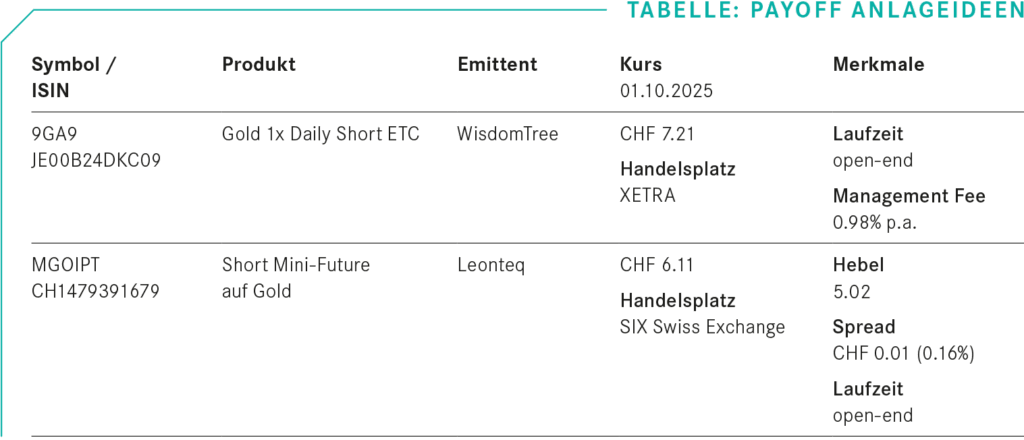
The bottom line is that the picture is ambivalent, but certainly attractive for short speculators. The market is highly valued, the fundamental drivers are beginning to crumble, the technical situation points to overbought conditions and the psychological component harbors considerable potential for correction. In the long term, gold will probably retain its role as a store of value, but in the short term, investors who have the courage to swim against the tide could have an advantage. Precisely because so many investors traditionally view the precious metal only as a long asset, the short side is an interesting field. Those who understand the mechanisms, carefully weigh up the timing and actively manage the risk could benefit from a falling gold price in the coming months.