

 Learning Curve
MSCI World: How Risky Is This Popular Core Investment?
-

Christian Ingerl
Redaktor
The MSCI World Index is regarded as the standard for international equity investing – yet, experts increasingly warn of concentration risk and insufficient diversification. What alternatives are open to investors, and how can they position their portfolios more smartly.
The MSCI World Index is one of the best-known share market barometers in the world. Millions of investors worldwide participate in its performance via a total of 94 exchangetraded funds. The MSCI World ETF SWDA by Shares alone manages more than USD 143 billion. The index, launched on 31 March 1986, is a core holding in the portfolios of countless retail investors – especially those taking their first steps on the share market. The diversification benefit of the MSCI World has always been emphasised. But it is precisely this argument that is increasingly wavering. Should investors actually avoid the MSCI World, as critics believe? If so, which alternatives are available?
No admission for emerging markets
A common criticism is that the MSCI World isn’t a “world benchmark” at all, since it completely excludes emerging markets such as China, South Korea or Brazil. That is correct. The barometer contains more than 1,300 titles, but only from so-called “developed markets” such as the US, Japan, Germany or Switzerland. Against this, however, it can be argued that the share of all emerging markets in global market capitalisation is only around 12%. Conversely, this means that the MSCI World covers nearly 90% of global share market value and can thus indeed set the direction as a global benchmark.
From a diversification point of view, however, the absence of emerging markets can be seen as a shortcoming. In addition, there are two other points for which the index is heavily criticised: on the one hand, the US dominance, and on the other, a heavy technology weighting. More than 72% of the index weight falls on US shares. Japan and the United Kingdom follow at 5.7% and 3.5% respectively, at a huge distance. Dependence on the US dollar is correspondingly high. If the greenback weakens against the domestic currency, the performance of the index is dragged down by exchange-rate losses – and vice versa.
Compounding this, the top ten components consist exclusively of US corporations such as Nvidia, Apple, Amazon or Microsoft. These ten names alone now account for nearly 28% of the index weight. This heavy reliance on US shares, particularly from the technology sector, carries an enormous concentration risk. Weakness or even a price slide in this segment would have serious consequences for the entire MSCI World. The mega-IPO of SpaceX, as well as the planned listings of AI developers OpenAI and Anthropic, could make the picture even more one-sided.
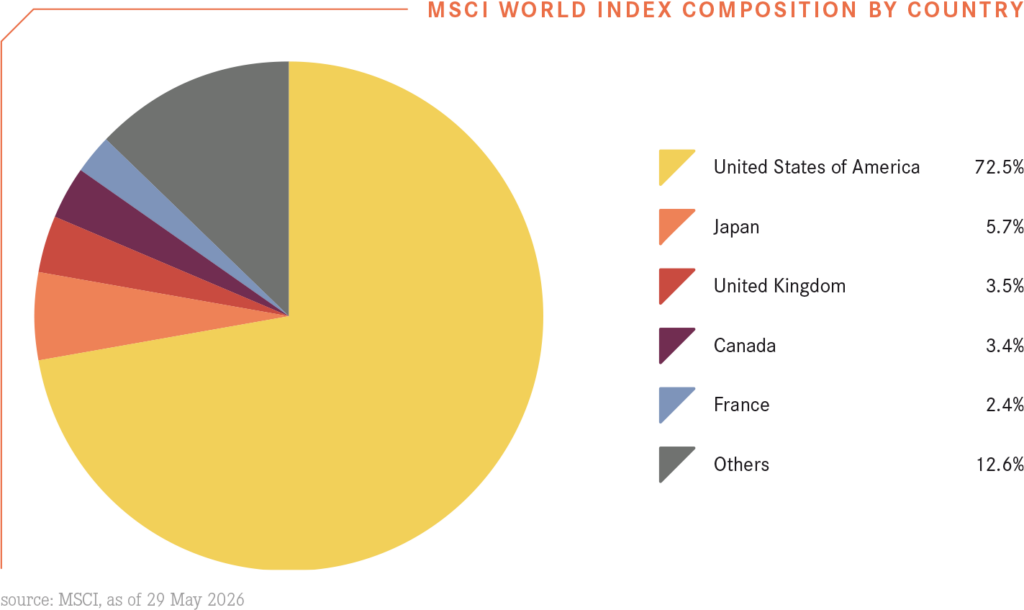
US Shares Were Outperformers
On the other hand, one must not forget that the above-average price gains of US technology shares have contributed significantly to the strong performance of the index in the recent past. Without US shares, the MSCI World would have achieved only an average annual performance of 9.2% over the past ten years. With US shares, that performance figure is 12.7%. Investors have thus, on average, earned a good third more in return per year thanks to the US. In the past, therefore, the high US weighting has paid off.
But does that still hold true today, even though concentration risks have clearly increased? Ultimately, each investor must decide this for himself. Investors who assume the US will remain the undisputed driving force of international share markets in the future should, in principle, have no objection to a high US weighting. For sceptics, however, it may make sense to look for alternatives to the MSCI World Index given the sharply increased currency, country and sector risks.
The Dominance Remains
One way out is offered by the MSCI All Country World Index (ACWI). It can be found, among others, with currency hedging in UBS’s ETF range (symbol: ACWIS). This benchmark is significantly more broadly spread than the classic MSCI World. The MSCI ACWI comprises around 2,700 companies from 23 developed and 24 emerging markets. This reduces the concentration risk emanating from individual countries and provides access to growth markets such as China, India or Brazil. So much for the theory. In practice, things look somewhat different. While the share of US shares, at around 63.5% of index weight, is no longer quite as dominant as in the classic MSCI World, growth markets are not really prominently represented. China’s share, for example, remains well below 3%. Moreover, the weight of the IT sector, at more than 32%, is similarly high as in the classic version. An additional alternative could be ETFs on the FTSE All-World Index. Vanguard tracks this benchmark passively under the symbol VWRL. With 4,248 titles from a total of 48 developed and emerging markets, the index is even more broadly positioned. But here too, the US (61.8%) and the technology sector (35.3%) are very strongly represented.
The Building-Block Principle
To reduce the weighting of Wall Street, capital can be split up. The S&P 500 Index is a suitable building block. Invesco trades the passive fund SPXS on the Wall Street barometer on SIX. For the second ETF, the base index could be an international benchmark without US shares, for example the MSCI World ex USA Index. The matching ETF, XUSE, comes from market leader iShares. The MSCI World ex USA Index follows the same methodology as the parent index but excludes US shares. Investors can determine the weighting between the two ETFs themselves according to their preferences. Anyone who considers 35% US equities appropriate, for instance, invests 35% of their capital in the S&P 500 ETF. The remaining 65% flows into the MSCI World ex USA ETF. Investors who don’t want to miss out on emerging markets can add an ETF on the MSCI Emerging Markets Index at the desired weight as a third component of a “world equity portfolio”. Amundi is represented on the Swiss exchange with such a product under the symbol AEEM.