

 Learning Curve
Market Making in Structured Products
-

Christian Ingerl
Redaktor
Trading in Structured Products works differently from trading in shares. It is not supply and demand that determine the price, but the issuer acting as a market maker. Here’s how it works and what you need to know.
As is well known, when trading shares and bonds, the price is determined by supply and demand. The buyer and seller are market participants who generally meet on a regulated stock exchange. If demand for a security exceeds supply, its price rises – and vice versa. Trading and price discovery work differently for Structured Products such as Barrier Reverse Convertibles, Factor Certificates or Call and Put Warrants. Here, the counterparty is the issuer, i.e. the entity that issues and offers the product. As a market maker, the issuer continuously quotes bid and ask prices, thereby determining the price of the product. A distinction must be made between the ask price (the price at which the issuer sells the product) and the bid price (the price at which the issuer buys the product).
The difference between the two variables is the spread. On the one hand, the spread is an important source of income for the issuer – and, therefore, also a cost factor for investors. On the other hand, the spread allows the issuer to hedge against liquidity and volatility risks. We will look at the specific features of the spread in more detail later.
How the market maker determines the price
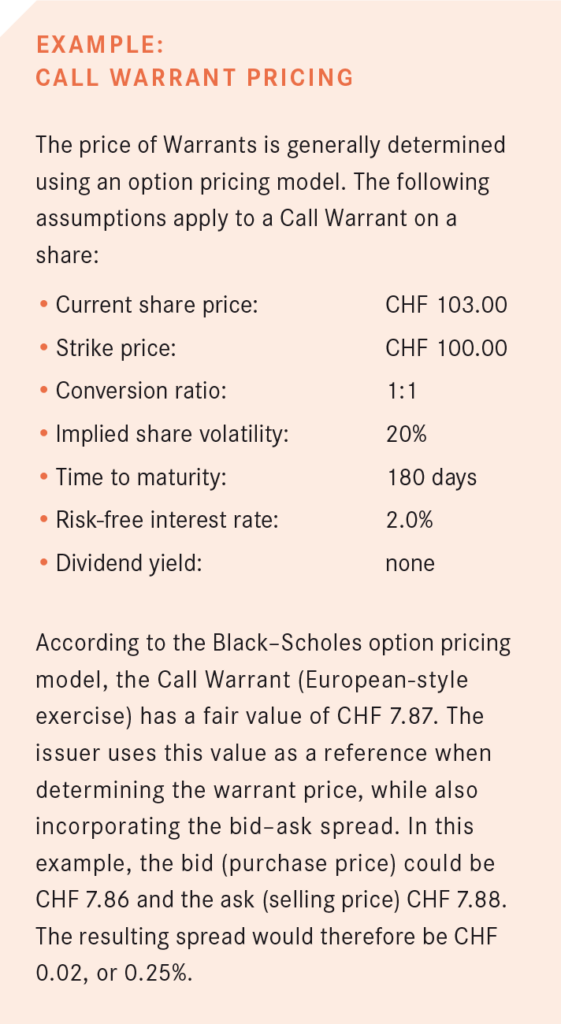
The issuer or market maker bases the price on the theoretical value of the product. Depending on the type of product, this depends, amongst other things, on the price of the underlying (e.g. a share, index, currency or commodity), the remaining maturity of the product, and the implied volatility of the underlying. Other key factors include the general level of interest rates, dividend expectations (for shares and performance indices), and product-specific features such as barriers or caps. Experienced investors recognise these parameters as relevant factors influencing the price of options. This is no coincidence, as most Structured Products contain some form of option component as a building block or, like warrants, resemble an option in their basic structure.
What affects the spread
IIn practice, the spread is of course not a constant figure; the issuer may, at times, set it lower or higher – depending on the product, underlying or trading phase. This is not arbitrary, but rather a matter of sound risk management. As already described, the spread is not only a source of income for the issuer, but also a means of hedging the issuer’s own risks. As a general rule, the more volatile an underlying or a product is, the wider the spread. This is because as price fluctuations increase, it becomes more difficult for the market maker to set prices and hedge the Structured Product. Leveraged products based on volatile growth shares will therefore, all other things being equal, have a wider spread than investment products based on stable blue-chip shares. The liquidity of the underlying also plays a significant role in determining the level of bid-ask spread. For products based on exotic or illiquid underlyings that are rarely traded, the difference between the bid and ask prices is usually significantly higher than for blue-chip stocks with high daily trading volumes.
Why trading hours are important
The regular trading hours of the underlying are also a key factor influencing the spread. This is because Structured Products can be traded outside the regular trading hours of the underlying. Products based on US equities can therefore be traded in Switzerland whilst Wall Street is still asleep. However, such transactions carry the risk for the market maker that they cannot hedge their position on the US stock exchanges. Consequently, they will therefore quote a higher spread for the product. This then falls as soon as the US stock exchanges open. The same applies to Swiss equities, provided they are traded outside official trading hours. For your information: at the end of 2025, SIX Swiss Exchange introduced a new trading segment with extended trading hours for Structured Products. This extension allows trading from 08:00 to 21:45 CET – almost six hours longer than before.
What constitutes good market making
Good market making is characterised in particular by three criteria: fair spreads, continuous price quoting and sufficient trading volume. Fair, and as narrow as possible, spreads are important because they represent a cost factor from the investor’s perspective. Continuous price quoting, in turn, ensures that, for example, a purchased product can be sold again at any time. However, as the past has shown, periods of stress occur time and again in which even the best market makers are forced to widen spreads considerably or, in a worst-case scenario, cease quoting bid and ask prices altogether. This can occur in the event of sudden and extreme price shocks affecting the underlying, but also when the underlying’s reference exchange suspends trading in individual securities or entire market segments as a result of certain events.
“payoff” makes market making measurable
The Payoff Market Making Index (PMMI) provides investors with insight into the quality of market making across different issuers and its development over time. The assessment is based on a points system that incorporates the criteria outlined in the previous paragraph. The PMMI indices are published every month in the payoff magazine.