

 Learning Curve
What Really Moves Currencies
-

Christian Ingerl
Redaktor
Exchange rates can sometimes seem unpredictable, but behind their fluctuations lies a complex interplay of economic data and market sentiment. Those who understand the key factors can better assess currency trends and manage risks more effectively.
Exchange rates determine the rate at which two currencies are exchanged, for example the Swiss franc and the US dollar or the euro. They are a fundamental link in global trade and enable smooth transactions on the international financial markets. Floating exchange rates are essentially determined by the interplay of supply and demand on the foreign exchange market. Incidentally: with a daily trading volume of USD 9.6 trillion, the forex market (short for “foreign exchange”) is by far the largest financial market in the world. However, supply and demand are influenced by several factors that are not always easy to understand. Nevertheless, investors should have a basic understanding of these relationships. After all, currency movements often determine the success or failure of investments in foreign currencies, such as US shares. Furthermore, there are numerous products whose returns are directly linked to the performance of a currency pair, for example, leveraged instruments based on the USD/CHF exchange rate. The key factors influencing exchange rates are described below.
Interest rates and monetary policy
Higher interest rates tend to make a currency more attractive, as investors can achieve higher returns in the country in question. This increases demand for that currency, which can lead to an appreciation. Conversely, falling interest rates in a currency area can lead to a depreciation of the corresponding currency. Central banks are primarily responsible for setting the interest rate level in an economy. Consequently, exchange rates often react more strongly than average to interest rate decisions – particularly when these are unexpected. Market participants also pay close attention to statements made by senior central bankers regarding future monetary policy. For example, an interest rate rise may have no effect on the foreign exchange market if the central bank governor simultaneously suggests that a turning point has now been reached.
Please note: The attractiveness of a currency cannot be assessed solely on the basis of interest rate levels. This is because high nominal interest rates do not automatically mean profitable investments. The decisive factor is the real interest rate, i.e. the nominal interest rate minus the inflation rate. As will become clear shortly, inflation is another important factor influencing currency movements.
Inflation and purchasing power
As a general rule, all other things being equal, higher inflation is unfavourable for the currency in question – and vice versa. The theory of purchasing power parity is based on this assumption. According to this theory, the exchange rate evolves over the long term in such a way as to equalise price differences between countries. If prices in country A rise faster than in country B, the currency of A tends to lose purchasing power and thus, in the long term, lose value against the currency of B.
An example: In Switzerland, the inflation rate is currently 0.4%. In the US, it currently stands at 3.4%. Therefore, the inflation differential is three percentage points. Assuming all other factors remain unchanged, the Swiss franc should appreciate against the US dollar. This would continue until Swiss products are relatively so expensive and US products relatively so cheap that demand for the US dollar increases accordingly and purchasing power parity is restored.
In practice, however, the relationship between purchasing power and inflation is quite complex. Monetary policy is also an important intervening factor here. If, for example, inflation rises, the central bank will probably raise interest rates. Higher interest rates, in turn, can attract foreign capital, thereby increasing demand for that currency. In this case, the currency may even appreciate despite the higher inflation.
Confidence in the government and the economy
As a rule, a strong economy, solid corporate profits and responsible fiscal policy strengthen confidence in a currency. Rising government debt, spiralling budget deficits and doubts about the solvency of a country, on the other hand, can put pressure on the currency in question. The US dollar has also been affected by this in the recent past. In times of geopolitical crises, however, currencies regarded as safe havens are often sought after. These still include the US dollar, which, despite the shortcomings described above, is regarded as the global reserve currency. An analysis by the Bank for International Settlements (BIS) shows just how strongly the US currency continues to dominate global foreign exchange markets. According to the analysis, the US dollar accounted for 89.2% of all transactions on the forex market last year.
Other factors
Another key factor that can trigger movements in the foreign exchange market is international trade. Admittedly, the share of world trade – that is, the export and import of goods and services – in the global foreign exchange market is merely between 2% and 5%. Nevertheless, punitive tariffs, trade restrictions or trade wars can weaken the exports of a country and thus put pressure on its currency. Nor should we forget the speculators. This group can cause sharp short-term exchange rate fluctuations, even when the economic situation has not yet changed at all.
Conclusion and overall assessment
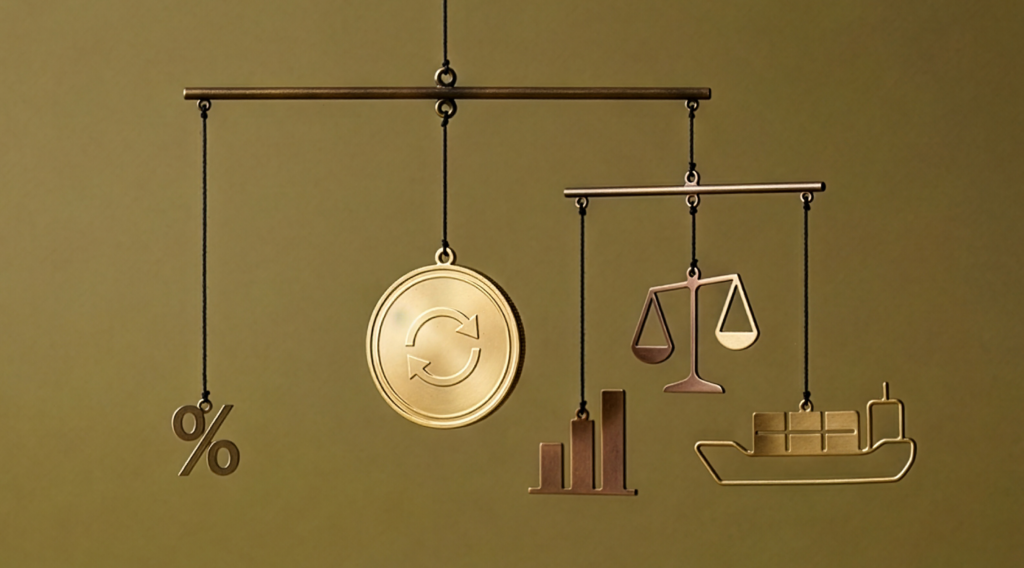
Exchange rates are the result of complex interrelationships between economic fundamentals, capital flows and expectations. In the short term, expectations and speculation may dominate; in the long term, however, economic fundamentals take on greater significance. Therefore, a sensible assessment should always consider several factors simultaneously and, in particular, take into account developments in comparison with trading partners.
To conclude, here is a rule of thumb: high interest rates, low inflation, a strong economy and political confidence tend to lead to a stronger currency. However, this rule is only intended as a guide and does not represent a fixed law.