

 Focus
Focus
Small but mighty: back the champions of tomorrow now
-

Serge Nussbaumer
Kapitalmarktexperte
In recent years, small caps have lagged behind large companies. Gradually, however, stock market favorites such as the “Magnificent 7” are showing the first signs of weakness. While the upward momentum of the big players is slowing down, the time has come for small caps. The current market conditions suggest a trend reversal for the small caps and offer investors new opportunities.
When the stock market bell rings at 9:00 a.m., the stock market world focuses almost exclusively on the giants Apple, Nestlé & Co. But while the blue chips are in the spotlight, exciting stories are also taking place away from the big stage. In the supporting roles: the small caps. They often lead a shadowy existence outside the attention of the broad investor masses, but behind the scenes some of the “small fish” are growing into the high-flyers of tomorrow. With their agility, innovative spirit and entrepreneurial courage to break new ground, they could be the coming stars of the capital market. So it’s time to keep an eye out for the hidden champions.
First, a general look at the small caps species: High flexibility, above-average growth and undervaluation are characteristics that are often mentioned in relation to small caps. In addition, small caps are often ahead on the stock market. Historical data shows that small caps tend to achieve a higher return than the big players over a complete investment cycle. “Investors are compensated for the higher risk in the long term. In addition, small caps offer valuable diversification benefits for a portfolio due to their low correlation with large caps,” explains Stefan Tang from the Lazard Systematic Equity team.
Small becomes big
History shows that many of today’s stock market giants once started out as unknown second-tier stocks. Just think of Nvidia, which went public shortly before the bursting of the new economy bubble and did not report any net price gains for many years. Today, the chip manufacturer is the most expensive listed company in the world. This example shows that smaller companies often have the potential to change entire industries and become the market leaders of tomorrow. Nevertheless, many fast-growing small caps fly “under the radar”, so to speak. The dominance of some mega caps such as the Magnificent Seven has led investors to ignore smaller stocks. The result: attractive valuations and undervalued opportunities in numerous profitable quality small-cap companies.
According to the motto “those who invest early in the future winners can profit above average”, it should be worthwhile to find real bargains in this less scrutinized segment. The second-line stocks on the old continent seem particularly interesting at the moment. Olaf Bartsch from DPAM refers to the rescue package for Germany, which could act as a potential catalyst for European small caps. In his opinion, most of the effects are likely to be felt from 2026.
Highly profitable and undervalued
This government stimulus coincides with a special market phase. “Firstly, nowhere have small caps outperformed as strongly as in Europe over the past 25 years,” explains Bartsch and continues: “Secondly, European small caps have underperformed over the past four years.” Such situations have occurred time and again over the past 25 years and have usually turned out to be buying opportunities in hindsight. This could also be the case this time, as the small caps are proving to be particularly profitable. “The earnings per share of European small caps have almost always performed better than those of large caps, both in the short and long term,” says DPAM expert Bartsch.


The picture is similar overseas, where inefficiencies also offer opportunities. “Despite higher forecast growth rates, the valuations of small caps are at one of the most attractive levels in decades compared to large caps,” states Lazard expert Tang. In this context, the portfolio manager points out that small caps are often under-analyzed: “While a large-cap company is rated by more than eleven analysts on average, there are often fewer than five for a small cap.” This offers opportunities to identify high-quality companies with attractive valuations. According to Lazard’s calculations, around 60% of active managers of small-cap funds beat their benchmark, compared to only around a tenth of large caps.
Second-line stocks on the move
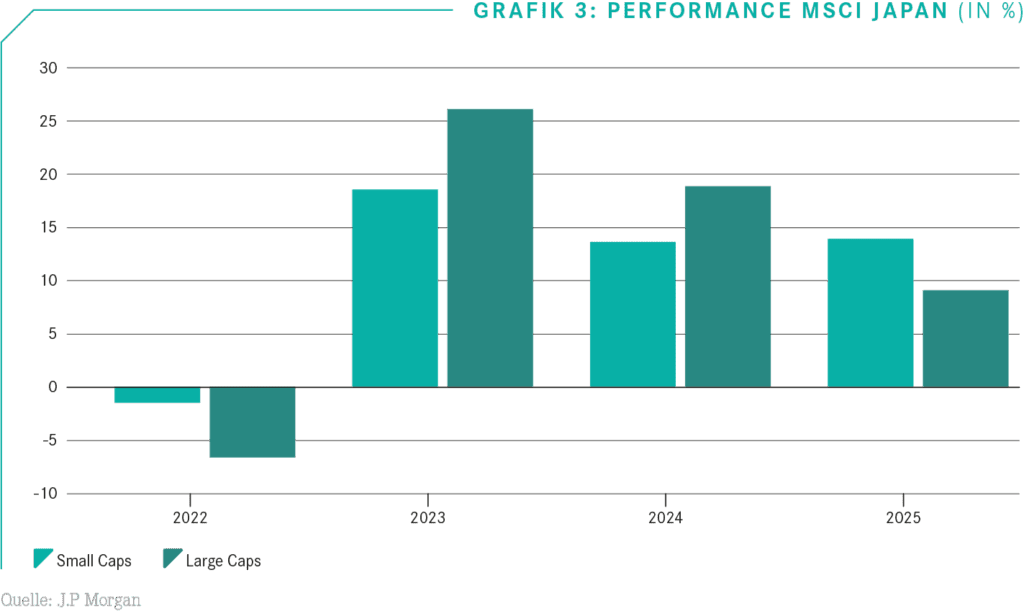
A look at the past few years shows that small caps have been inferior to large corporations on the stock market. This is true on the old continent, in the USA and also in the Far East. However, the tide is currently turning. While the small caps lost out in 2023 and 2024, they are gaining ground this year. The biggest discrepancy can be seen in Japan, where small caps have outperformed by almost 5 percentage points. In the eurozone, the gap is also over 4%. Meanwhile, US small caps are still lagging behind the large caps. However, there has also been a clear upward move here recently. On August 22, for example, the Russel 2000 recorded one of the broadest upward movements since April and also one of the strongest rises since 2010.
“Healthy” talents
Undiscovered gems can be found in many areas. Take biotech, for example: in the healthcare sector in particular, small research companies are constantly delivering groundbreaking innovations, be it in new therapies for rare diseases or through the use of AI in drug research. The industry is growing rapidly: according to a report by Towards Healthcare, the global biotech market is expected to grow at a compound annual growth rate of 12.5% between now and 2034, reaching a value of USD 5.04 trillion. Small-cap biotechs are often the think tanks driving this momentum. Take Tiziana Life, for example. Thanks to progress with a novel antibody drug, the US stock has almost tripled in value this year.
But there are also interesting biotech companies in Switzerland, such as Santhera. The share price has doubled since the beginning of December 2024. The company recently celebrated another success for its Duchenne muscular dystrophy drug Agamree, which helps treat a rare, progressive muscle disease. An exclusive distribution agreement was signed with Uniphar in five countries in the Middle East. Sales are expected to start in the first quarter of 2026, with broader commercial distribution expected after market approval at the end of 2026.

The medical technology sector is also considered interesting within the healthcare industry. Medacta, which is little known in this country, is currently doing particularly well. After a strong first half of the year – sales revenue increased by 19.8% to EUR 344.1 million – the orthopaedics company has revised its forecasts upwards. In 2025, currency-adjusted sales growth of 16% to 18% (previously: 13% to 15%) and an adjusted operating profit margin (EBITDA) of 28% (previously: 27%) are now expected. In the medium term, sales growth of 10% to 14% and an EBITDA margin of 28% are now being targeted.
High-growth eco-trend
Another megatrend is green energy: the global decarbonization of the economy is playing into the hands of small innovators. While established energy companies are still working on restructuring their business models in many places, small caps in this sector are often already developing the technologies of tomorrow. One example is Vulcan Engery. The Australian-German start-up wants to produceCO2-free lithium for batteries and recently received over EUR 100 million in funding for this. Such companies occupy key positions in the energy transition and could grow disproportionately with the global climate protection push.
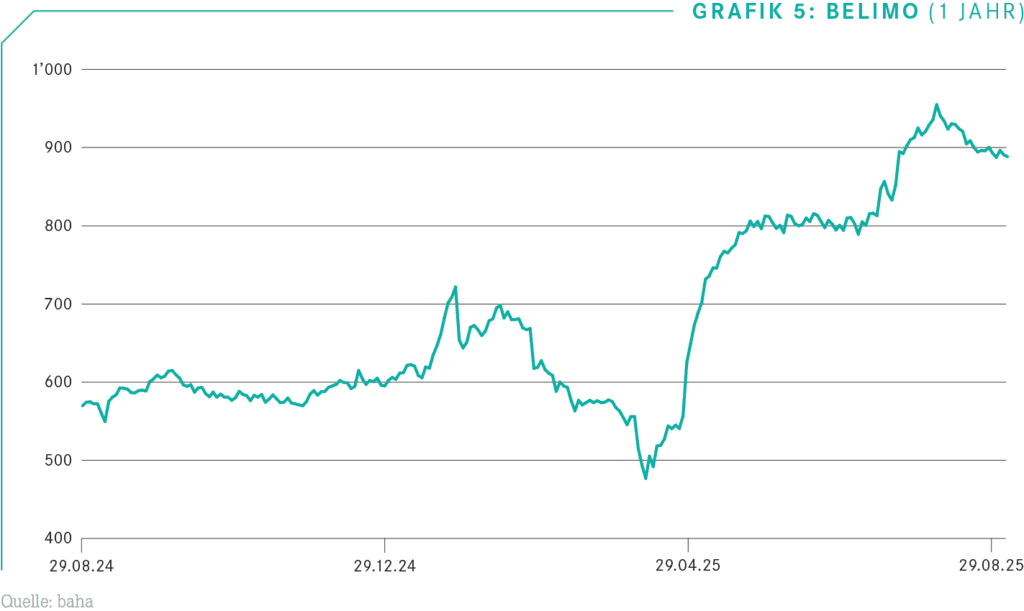
Swiss company Belimo also falls into this category. The global market leader in field devices for the energy-efficient control of heating, ventilation and air conditioning systems increased its sales by 20.6% to CHF 561.5 million in the first half of the year, while the EBIT margin improved by 320 basis points to 22.8% thanks to economies of scale and an advantageous product mix. Growth was driven by the “Americas” region, which accounts for around half of Group sales. A flourishing data center business and the successful market launch of Belimo’s next-generation cooling technologies for high-end servers had a positive impact here. For the year as a whole, the company is forecasting organic sales growth of 15% to 20% and an EBIT margin of over 20%.
Cutting-edge technology and coveted raw materials from a small source
Small tech companies also often occupy profitable niches in specialized technologies such as AI & Co. that seem too specific or risky for large corporations. For example, Seeing Machines, which is worth less than CHF 200 million, is developing an AI-supported driver monitoring system that detects driver distraction and fatigue. A new EU regulation requires such driver monitoring systems for new cars from 2024, which could provide a huge tailwind for the small cap in the long term.
There are also opportunities in the raw materials sector: whether lithium, rare earths or uranium, the supply of raw materials is scarce and offers growth opportunities for smaller mining and processing companies. One example is the uranium specialist Centrus Energy. Despite a market capitalization of only around USD 600 million and low analyst coverage – i.e. a typical “under-the-radar” stock – the share is considered to have great potential. The global trend towards low-carbon energy and the tech giants’ immense hunger for electricity play into the company’s hands. While demand for uranium for new nuclear power plants is increasing, supply will remain scarce in the long term. In the second quarter, Centrus pulverized its sales expectations of USD 127.2 million with USD 154.5 million. Stock market participants are applauding: the share price has already more than tripled this year.

Conclusion: Small values, big opportunities
Even if small caps are occasionally overshadowed by blue chips, it is worth taking a look at the second tier. The combination of low valuations and high innovative strength makes this segment particularly attractive for investors. Of course, an investment in second-tier stocks is subject to higher fluctuations, but those who diversify into quality stocks are likely to be rewarded in the end. There are several ways to add a broad selection of small caps to your portfolio without much effort. Both passive financial vehicles such as trackers or ETFs and actively managed funds are available. The latter category includes the UBS Small Caps Switzerland fund. This focuses on small Swiss companies with a market capitalization of less than CHF 4.0 billion. When selecting stocks, the portfolio management team focuses primarily on the flexibility and innovative strength of the respective companies. The largest sectors in the fund are currently industry and finance, with the top five stocks being Cembra Money Bank, Valiant, Also, Medacta and PSP Swiss Property. The fund is up around 13% in the current year.
The tracker certificate on the GKB Swiss Small Caps ESG Basket was even faster. The participation certificate has posted a performance of more than 17% since the start of the year. The basket is not fixed, but is reviewed quarterly. The stock selection is based on the GKB multi-factor model, which takes into account important factors such as a company’s quality, momentum, valuation and ESG rating. The 20 members are equally weighted.
Small caps also offer opportunities outside Switzerland. This applies to Europe and the USA as well as Japan. The three-person management team of the J.P. Morgan Europe Small Cap Fund has recently done a good job, gaining more than a fifth in value this year. This means that the fund has significantly outperformed the MSCI Europe Small Cap Index, which has “only” gained around 13%. The corresponding ETF from SPDR, on the other hand, has a low total expense ratio of 0.30% p.a., while the actively managed portfolio incurs ongoing charges of 1.75% p.a. However, due to the current strong outperformance, the higher fees are hardly significant.
Active and passive investing is also possible in the USA. The US Smaller Companies fund from T. Rowe Price offers a dynamic approach, while the ETF on the Russell 2000 US Small Cap Quality from L&G concentrates on tracking the index. Of these two, the ETF has come out on top this year with an increase of around 7%. Small caps in Japan have performed even more strongly this year. The MSCI Japan Small Cap is up by more than 22% and can be easily and cost-effectively added to your portfolio with the ETF IE00B2QWDY88 from iShares. If you want to position yourself in the second and third tier of stock markets worldwide, take a look at the SPDR MSCI World Small Cap ETF. Its performance of 14% since New Year’s Eve is also quite impressive.